











The IDF strike on Nasser Hospital that killed five journalists highlights the risks faced by local reporters — and the world’s reliance on them
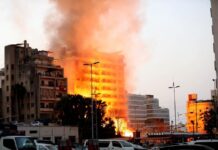
Israeli shells struck Nasser Hospital in Khan Yunis in Gaza on Monday, killing at least 20 people — among them five journalists. Those killed included freelancers working with Reuters, my own alma mater the Associated Press, and Al Jazeera. Does that make it matter more? The Prime Minister’s Office seemed to think so, issuing a rare statement expressing “deep regret.” Netanyahu, rather like Edith Piaf, does not normally do regret.
The IDF acknowledged the strike and announced a inquiry, insisting it “does not target journalists as such.” Officials suggested that some press equipment, including a camera, might have been mistaken for a weapon. I’ll add that Hamas is by no means above using hospitals, schools, mosques, aid sites and the like for its activities, which the world is quite naive about; the group does this because, like all jihadists, it seeks martyrdom for its people as a source of twisted strength.
The incident prompted strong condemnation from the UN Secretary-General, as well as leaders of the UK, France, and Germany, all calling for an impartial investigation. Coming a few months after the Committee to Protect Journalists released a report finding that Gaza is the deadliest conflict for reporters in modern history, let’s just say this looks very, very bad.
The matter is especially delicate given that foreign correspondents have been barred from entering Gaza for nearly two years, leaving coverage almost entirely in the hands of Palestinian journalists working under extreme risk. I understand Israel’s concern that they may be hurt — but you cannot keep a significant territory whose two million people are locked in and under great duress out of contact for almost two years. Better to outline the dangers and the ground-rules and let the press in, disavowing responsibility; I actually wonder who’d go.
Against this insane backdrop, I spoke with the Canadian Broadcasting Corporation (and others) about the strike and the broader dilemmas. Below is the transcript of that conversation.
Hilary Johnston: I want to welcome World Affairs Analyst Dan Perry in Tel Aviv. He served as the Associated Press’s chief editor for the Middle East, Europe and Africa. So, Dan, welcome to the program. Thank you for making some time for us today. I’m hoping that we can start here with your reaction to what we were just hearing there from my colleague, Julia. That five journalists have been killed bringing that number to nearly 200 at this point. What is your reaction to that?
Dan Perry: It’s clearly a terrible tragedy that all these people are losing their lives in the war that, at this point, probably needs to end as soon as possible. Clearly, as a journalist and a former head of the Foreign Press Association in Israel and the Palestinian areas, I’m acutely aware of the need for freedom of access and for protection of people who risk their lives to cover war zones. But on the other hand, the journalist’s life is not worth more than that of a regular civilian.
Here we are talking about this event, but tens of people, dozens of people, die in Gaza on a regular basis, and we don’t have that conversation. Look, I don’t think Israel targets journalists in order to prevent the truth from getting out. If for nothing else, they’re simply not that stupid, they do know that a systematic killing of journalists would look bad.
And I don’t think they’re necessarily trying to hide anything here. The truth of what’s going on is rather plainly evident. What is the case, however, is that they – I think they’ve developed a certain callousness, not indifference but callousness, to this kind of event as part of a general despair dealing with what is a very, very difficult situation. And one in which one could suspect that the idea of after all this time that Hamas refuses to surrender might have developed a little bit of a light trigger finger. It’s also true. It’s also true that they don’t tend to give blanket immunity to people who claim they’re journalists.
In other words, the fact that there may have been journalists in the area doesn’t maybe give them as much pause as it should, perhaps purely out of reputational considerations, partly because they believe – and this belief is not completely without reason – that in many cases, people who claim they’re journalists and who carry a camera are, in fact, either working for Hamas as propagandists or, more relevantly, are simply Hamas undercover. We can’t prove this, of course, because no foreign correspondence can go in. It’s an extremely messy situation.
HJ: Well, and I’m hoping that we can talk a little bit more about that, because I hear your point, of course, that the life of a journalist is not worth more than the lives of other people who have been killed. And as you’ve pointed out, there were others killed in that attack as well who are not journalists. But can you help our viewers understand the role that some of those Palestinians are playing in these journalist roles, why that is important in terms of what we then hear and find out and learn about the conflict?
DP: Well, basically, there is no other type of journalist in Gaza. Foreigners have not been allowed to go in since the war began. And so all there is, really, is local journalism, which is categorically not free, and so it’s less useful, and local journalists who work for foreign media. Israel will claim that many of those are somehow either intimidated by Hamas or even working with Hamas.
I can tell you that when I was the head of AP in a region and a head of the local bureau as well for a time, years ago, we did our best to vet the people that we hired. You can do a little bit less of that with freelancers, where it’s a little bit more ad hoc. But by and large, by and large, the Palestinians who work with the foreign media out of Gaza are very brave, and they do their best in a difficult situation.
And I have to say, in an environment where Palestinians, where Gazans, have been very much radicalized by 18 years of rule by Hamas, which basically educates their people to jihad and youth to jihad, these are journalists who agree to work with bosses in Jerusalem often who are Israelis and Jews. They are in a very precarious position, and yet they do it. Many of them are really dedicated and excellent journalists. So I find Israel’s blanket dismissal of all of them is — sometimes it can seem like that’s what they do — is very unfair.
That said, it can’t be denied that Gaza is one of those places in the world that is an unfree environment. And you have to be very naive indeed to think that that doesn’t stay the hand sometimes of journalists who operate in that environment, and it’s not unique to Gaza. You see this everywhere, where you have a government that is despotic from North Korea and China even, in a different way, to certainly Russia today and Cuba, and much of the Arab world. That’s just the reality, and what media should do in that situation really is an open question. Maybe we should sometimes be more open about the fact. And you know what? It also applies to a police writer who’s reporting on the mafia in New Jersey. Are they really free? In Gaza, they’re very much not free. And so it’s a complex environment.
HJ: I know that you have reported from this region for decades. Do you believe that there’s a potential here that we might be at an inflection point after this conflict has now raged on for nearly two years? How do you sort of view this in terms of other conflicts that you have covered in this region in recent decades?
DP: Well, it depends on how it goes. If the war really ends in two or three weeks, as President Trump is now claiming, that’s one scenario. And indeed, if this government is defenestrated in the next election, as polls show that it will be and those elections have to be by next year, and the result is a more moderate government, that changes the landscape entirely. If the war goes on forever, or at least if we enter a period of prolonged insurrection and Israel reoccupies Gaza City itself and basically installs a military government over two million Palestinians, that’s one situation.
However, I certainly do see a potential inflection point, where without diminishing in any way the horror and the tragedy of what’s unfolded in the past two years, we might be looking at this as the moment that is darkest before the dawn. Because two years ago, we had a situation where Iran had militias arrayed all over the region, undermining the sovereignty of all these countries and surrounding Israel with what they called a ring of fire, and basically hankering for war and Hamas in charge of Gaza. And we could well see a situation where in a few months Hamas is no longer in charge of Gaza, and make no mistake, that is a favor for the Gazans. And it is something that today they mostly would yearn for.
And who knows, maybe Israel can find a way to make peace with Saudi Arabia and even Lebanon and Syria. It’s not inconceivable with the weakening and chastening of the influence of Iran and its militias in the region.
And for massive extra credit, here’s an earlier discussion about the same event on India’s NewsX. Not an easy day.
