



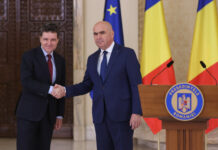





- Nicușor Dan, Bucharest, June 30, 2026: “(…) From my perspective, I am not asking for any agreement, any conditions, only for there to be 233 votes.”
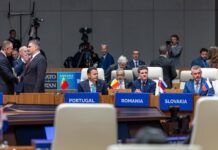
- Nicușor Dan, Ankara, July 8, 2026: “The answer is no”. the Romanian head of state said at the NATO summit in Ankara when asked whether he would invest a government that depended on votes from AUR.
It’s evident that the president has changed his mind in the last two weeks.
- On June 22, Adrian Veștea went to the AUR headquarters, looking for votes to get his government invested. There was silence from the Cotroceni presidential Palace, with no reaction to the fact that his nominated prime minister was violating the red line drawn by Nicușor Dan himself to exclude any support from the extremist party.
- On June 30, Nicușor Dan even said clearly that he was only interested in finding 233 votes, regardless of where they came from (see first quote).
- But on July 8, back to the red line, with Nicușor Dan saying clearly that he does not want votes from AUR for the future government.
The next question is how long the president’s new approach will last. It is a legitimate one, given that he has reversed course on his own red line.
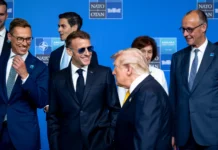
Another question is what changed from June 22 and 30 to July 8, regarding Nicușor Dan’s relationship to the possible support from some AUR lawmakers in the installation of the future government? From this point of view, Dan looks more and more like the American president, whose attention he begs for.
In the absence of the president offering any clarifications, it’s reasonable to suspect that his change of mind comes after the resumption of consultations with the parties on Monday. Consultations with the ethnic Hungarian party, the UDMR, whose votes are needed but will never give if the government is also supported by AUR.
It remains unclear how Nicușor Dan will manage, during the next round of consultations on Monday, to convince the pro-Western parties or even to force their hand to get a government installed more quickly.
And the lack of clarity was fueled in Ankara, when the president said he was powerless: “I don’t have tools.” It is a bizarre style of negotiating to say the least – bluntly stating that you are powerlessness in front of different parties you have to negotiate with.
The full quote is here:
- “I can’t specify when this consensus will be reached and especially I don’t have the tools. The President of Romania does not draw up files, blackmail, whatever else you can imagine … to persuade politicians to say yes, when they want to say no. We are in a democracy where politicians have to reach a consensus. That’s their job.”
An interesting point is that Nicușor Dan does imagine exercising his presidential influence other than through underground mechanisms (see the reference to ” files, blackmail, whatever else you can imagine files”). It shows a curious lack of imagination, since the president has enough solid tributes to act efficiently and above all transparently.
Another remark that “politicians must reach a consensus” because “this is their job”. Wrong!
Politicians sometimes have to reach consensus, and sometimes they don’t, because that’s democracy. It depends on the situation, the files, etc.
In the case of investing a government, the Constitution states that consensus is not mandatory, since, in the absence of consensus, Parliament can be dissolved and early elections called.
At the same time, the duty of the president is to designate a prime minister, and the duty of the prime minister-designate and his party or coalition is to find the necessary votes.
The fact that Nicușor Dan placed the cart before the horse – finding a majority and only then appointing a prime minister – is not likely to legitimize the ignorance/defiance of the political and constitutional reality; and it is even less likely to alter the substance of political and constitutional reality.
On Tuesday, in Ankara, the head of state actually left the impression that, against the background of his increasingly poor personal image, he is trying to justify a mixture of inaction and bad action onto the shoulders of the parties who will form the next government.
It is unfair, immoral gesture and impractical approach, given the generous prerogatives that the president has.
Although the parties, to different degrees, are at fault for triggering and prolonging the political crisis, the head of state is at greater fault.
And he’s more at fault because he refused to carry out his role. Initially, he failed to stop the PSD from bringing down the government. Now he is refuse to nominate a prime minister and send the nomination to Parliament, which may or may not lead to snap elections.
The very fact the political crisis has gone on for more than two months and we still don’t have a government invested or early elections triggered, is primarily the responsibility of the president.
The fact that underground things rather than transparent policy are beginning to happen is also attributable to the head of state.
The situation in which the National Liberal Party finds itself is the most telling.
Initially, President Dan upset the party with his complicity with the PSD in ousting the Bolojan Government and then nominating Adrian Veștea as prime minister.
Now, the party is on the verge of being broken up not by political instruments (however questionable they may be), but the legal system, a deeply discredited system, that president had promised to reform, only once he elected embraced it like a lost relative.
The first phase of coup against the PNL failed (immediately after the no-confidence vote and the Veștea episode). Now we are witnessing what appears to be the second phase.
The first phase dented the president’s image badly and the second phase is taking place at the cost of an already compromised justice system.
If Nicușor Dan prolongs the political crisis, much of Romania’s institutional fabric risks emerging tarnished and compromised. The same applies to Romanians’ trust in the state, the rule of law, and democracy.
If he ever takes off the blinkers and looks at the real world, Nicușor Dan will be surprised to notice that it’s completely different from what he imagines.
Perhaps, in the end, the justice system will bury Bolojan’s PNL as neither Nicușor Dan nor PSD succeeded in the initial phase.
But the latest polls indicate that, in the real world, the mood is completely different. Ilie Bolojan and a good chunk of the PNL, and together with them and USR, are moving quickly away from the point where they could be stamped out by resorting to the old methods.
Fueled by divisive presidential interventions and complicity between politics and the justice, system, Romania’s political system is undergoing an unexpected transformation. It can’t be ruled out that the losers in the medium and long term are those who are betting everything today on a victory obtained in an underhand way in the short term.
Romanian president doesn’t think US troops will pull out from NATO’s eastern flank
