









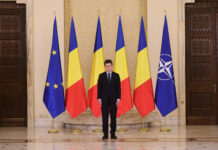


The United States was designed to resist kings; it now behaves as if it has one.
Is the Iran war paused or ended and what terms can America live with? Well, it’s basically up to Trump, as the Republicans who control Congress have handed him their war powers. Will the US attack Cuba? Trump decides. Back down on tariffs? Trump. Return to the World Health Organization? Pull out of NATO? Ditch the United Nations? Resume threats against Greenland? All of it is down to Trump.
On pretty much every consequential issue of the day, everyone awaits his word. Many problems that have everyone on edge would never even have existed had Trump not conjured them out of thin air – like the obsession with Canada, or windmills, for that matter. Saying that it’s not normal is very first-term. It’s much more: a shocking mutation of what the American republic was meant to be.
And that’s why the world’s top democracy watchdog group recently downrated the US from the top rank of “liberal democracy” to “electoral democracy” where leaders are elected but not much more. “The speed with which American democracy is currently dismantled is unprecedented in modern history,” said the report from the Sweden-based Varieties of Democracies Institute (V-Dem), noting that the “suppression and intimidation of media and dissenting voices” mean that freedom of expression in the US “is now at its lowest level since the end of WWII.”
Please read on as the paywall has been removed — but consider an upgrade to a Paid Subscription. You will be enabling independent reportage and commentary, joining a growing new community, and unlocking access to all content.
Trump personifies this focus on personality by being, well, focused on his person. He constantly speaks of getting (or being denied) credit (sometimes adding “but that doesn’t matter”), reports on which other leaders “like” him, brags of how respected he is (”they call me sir”) and lobbies for the Nobel Peace Prize.
The framers of the Constitution, wary of monarchy in all its guises, designed a system meant to frustrate exactly this kind of situation. War required deliberation. Commerce required legislation. Alliances required consent. Each branch was to jealous guarding its prerogatives, with the friction as a virtue.
That friction has worn away. What remains is a presidency capable of initiating major economic confrontations, redefining alliances, and steering the course of war with remarkably little effective constraint.
Consider trade. Tariffs, once the product of painstaking legislative doctrine, have become instruments of personal leverage. Entire sectors of the global economy have been jolted by decisions that emerged from Trump’s instinct and grievance (in one case, over a Canadian TV ad). The result is volatility that allies and adversaries alike struggle to interpret, because it does not follow the predictable rhythms of a system. It follows an unpredictable person with an insatiable ego.
Foreign policy, once the domain of calibrated signals and layered consultations, suffers the same. The idea of acquiring Greenland and possibly seizing it from a NATO ally, floated and discarded with startling casualness, captured the new reality in miniature. It was not a policy debate so much as a personal obsession elevated briefly to the level of a global strategic emergency, then seemingly discarded: there were real concerns that the damage to NATO was so great that China might seize the moment to invade Taiwan.
Relations with Canada, the most stable of partnerships, have been subjected to rhetorical swings that would once have been unthinkable. Trump has mused about annexing it, and calls its prime minister “governor.”
The war in Ukraine brings the stakes into sharper focus. Support for a country resisting aggression had been framed as a matter of principle and strategic interest. Trump just pulled the plug – even suggesting, preposterously, that of the two, Ukraine is the aggressor and dictatorship.
American history offers examples of executive overreach and bold unilateral action. The difference lies in the totality of it, and the abdication of the ecosystem that might have offered restraint.
Congress, theoretically the first branch, has shown little appetite for reclaiming its powers. The bureaucracy, maligned in Trumpworld as the “deep state,” has in practice proven more malleable than many assumed.
And, critically, Trump has figured out that the courts, by design deliberative and reactive, move too slowly to shape events in real time – so the president can break the law for quite some time. And the Supreme Court is now so conservative that it has mostly been a pushover. The recent ruling against Trump’s tariffs was a massive exception, earning his rage and seeming surprise.
The culture has adapted in ways that reinforce the trend. Media coverage gravitates toward the personal, amplifying the central figure and reducing the visibility of the broader – and more boring – system. Political allies recede into the background, their roles diminished to that of endorsers or implementers.
Interestingly, though Trump has benefitted from the media’s slide into simplemindedness, he hates it — the same as any autocrat.
There is also a feedback loop at work. As power becomes more visibly concentrated, public attention narrows further, which in turn enhances the perception of that concentration – and its normalization. It starts to feel natural to ask what the president will do, to wait for his signal, to interpret his statements as decisive. Other actors fade from view.
All this is amplified by social media, which is increasingly dominant and which naturally gravitates not to deliberations, institutions, or process, but to “influencers” – the individual.
In this unfortunate situation, the personal qualities of the individual who has somehow come to occupy this position are crucial. We must hope that, at the very least, this person possesses sound judgment, deep knowledge, profound wisdom, and rigorous discipline, on top of decency, probity and respect for the boundaries of the office.
Instead we have Trump.
We have impulsiveness, a taste for spectacle, a transactional view of relationships, and a loose regard for truth, all taking on greater significance than when there checks to absorb or counterbalance them. Even at the level that existed during Trump’s first term. It’s some that, as he would say, “nobody’s ever seen before.”
The result lies before us: essentially a semi-authoritarian state where anything could happen, and citizens’ rights are not quite guaranteed.
I am old enough to remember every US president since Richard Nixon, and there has been nothing remotely close to any of this. “I am not a crook,” insisted Nixon, somewhat adorably, though not so believably. Trump says he can shoot someone on Fifth Avenue and get away with it. “I am a crook,” he basically says, then tweets images of himself as Jesus, or something of the sort.
This sordid spectacle carries a particular poignancy in a country that has long presented itself as a model of institutional strength and democratic resilience. To see it thus diminished is to witness a tragedy.
There is still time to fix this. The US has endured crises before. Its resilience has often derived from a capacity to correct course, to restore balance after periods of excess. The mechanisms exist, embedded in the Constitution. But for the moment they are useless, since the Republicans are rolling over. A party that once prided itself on constitutional principle now finds itself aligned with a style of governance that – to put it mildly – sits uneasily with democracy.
These lemmings fear bring turfed out by primary voters, should Trump turn on them. That’s understandable, but not too leaderlike and very undignified. If they cannot grow a spine, we might find voters in the midterm election handing them the kind of spanking that, as Trump himself might say, they’ve never seen before
