












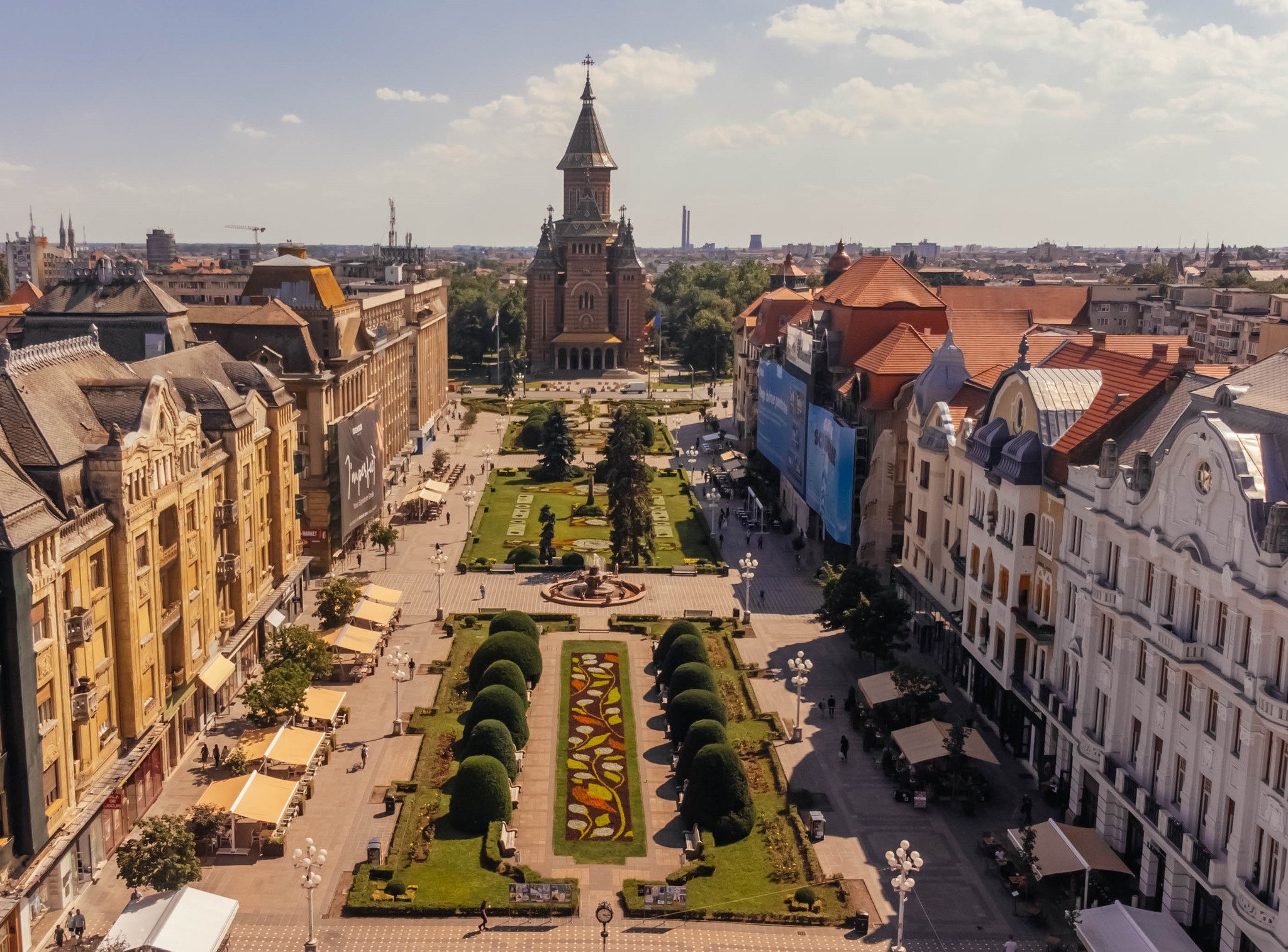
Timișoara marked Earth Day with the completion of three new urban regeneration projects, expanding the city’s green infrastructure through the creation of two mini urban forests and a 450-square-meter urban meadow along the banks of the Bega River.
Over recent weeks, the city has added more than 5,300 trees, shrubs and perennial plants through a series of biodiversity-focused interventions aimed at improving urban living conditions and ecological resilience.
Two previously unused plots of land—one in the Bucovina district on Constantin Stere Street and another in the Blașcovici district on Dunărea Street—have been transformed into dense mini forests using the Miyawaki method.
The Miyawaki method is a technique designed to accelerate forest growth in urban environments. Along the Bega, two urban meadows covering a total of 450 square metres have also been established, featuring more than 85 species of flowers and over 500 shrubs.
The largest intervention took place in the Bucovina district, where a degraded space between apartment blocks has been converted into a compact urban forest and a landscaped clearing intended as a new community green area. Around 280 volunteers planted approximately 3,900 trees and shrubs from 11 species across nearly a hectare. The site also includes a small open meadow designed as a relaxation space for residents. Participants in the planting effort included local residents, students from the West University of Timișoara, representatives of partner companies, and members of the local administration, including Deputy Mayor Paula-Ana Romocean.
A second urban forest was established in Blașcovici, where 1,200 trees and shrubs from 11 species were planted across a 1,000-square-metre area. The project forms part of a broader strategy to expand green spaces in neighbourhoods where access to nature has a direct impact on quality of life.
The two urban meadows along the Bega complement these efforts by introducing a biodiversity-focused component, supporting pollinators and contributing to the development of more resilient urban habitats.
The projects are part of the “România plantează pentru mâine” (Romania Plants for Tomorrow) program, one of the country’s largest privately funded planting initiatives.
Mayor Dominic Fritz has pointed out that the partnership demonstrates how public authorities, private companies and civil society can work together to improve urban environments.
Also, Act for Tomorrow President Andrei Coșuleanu emphasized that the initiative aims to bring regeneration efforts directly into communities where their impact is most tangible, while also attracting further private-sector involvement to support long-term green development.
These projects build on earlier interventions carried out in Timișoara since last year, including initiatives in the Fabric and Calea Șagului districts, where 400 volunteers planted around 10,000 trees, shrubs and perennials. The newly created green spaces (reported to have a survival rate of over 75 percent) highlight the continuity of a partnership focused on testing and scaling practical urban regeneration solutions through collaboration between local authorities, businesses and the community.
The initiative was carried out by the Timișoara City Hall in partnership with Act for Tomorrow, with support from OMV Petrom.
photos-romanias-history-goes-on-a-national-tour-starting-with-the-story-of-king-michaels-life
