














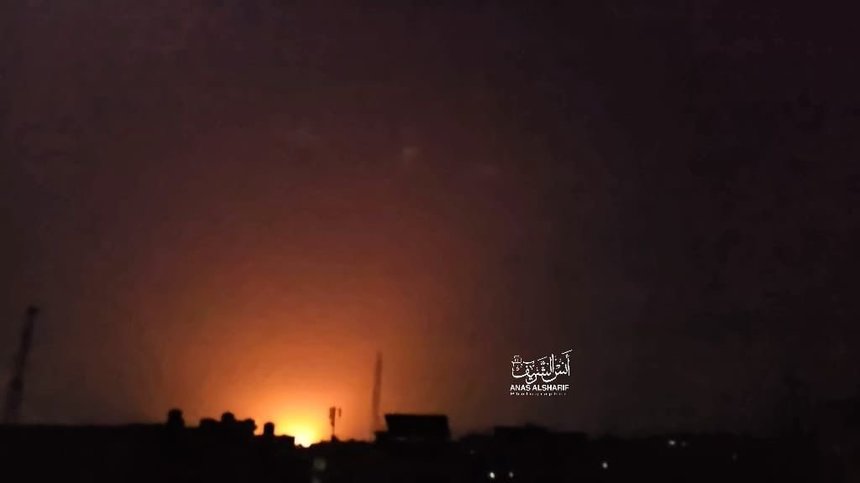
The Gaza war drags on without any plan for “the day after” as Israel’s far-right coalition partners dream of reoccupation and expulsion. Yet the outlines of a ceasefire deal already exist: release the hostages, halt the fighting, begin reconstruction conditioned on Hamas leaving. The Israeli public yearns for it as does the US president, not because he cares about Gazans but because the whole thing is now a very, very, very bad look.
The problem, as I explained on NewsNation, is that “Israel’s government is basically propped up by far-right parties that want the long-term plan to be occupation (and) resettlement of Gaza with Jews.” Netanyahu, bound to humor them, “hasn’t had, as far as I know, one single discussion about this.” It is an astounding strategic drift. And since Israel cannot continue the war without US backing, I said, Washington unique leverage. Earth to Trump.
Here’s what’s at stake:
There is a deal on the table that essentially would return all of Israel’s hostages and end the war. At that point, there would be non-military pressure on Hamas from the entire world to disarm and hand over the Gaza Strip to an international consortium fronted by the Palestinian Authority. What stands in the way is Netanyahu’s survival instinct. But here’s the twist: he wouldn’t actually fall.
“The Israeli moderate opposition has said that if they do a deal, they will not bring down a government, even if it loses its majority,” I explained. “They will give Bibi an umbrella of eight, 10 months, up until an agreed date for elections.” Elections must happen by October 2026 regardless. In other words, Netanyahu could end the war and still stay in office. Which is all he cares about, sadly.
That’s why a decisive shove from Washington matters. Asked if Trump could deliver it, I said: “Oh, I think Trump can have one phone call that lasts 10 seconds.” What would that sound like? “‘Hey, sign it, Bibi. This is it.’” Would it work? “Yeah, it would happen. And he would have no choice.”
Netanyahu’s “Louis XIV complex” — his conviction that “he has to be in power” — is what keeps him paralyzed. But the combination of overwhelming public opinion, looming elections, and Trump’s indifference to the details of Gaza’s destruction creates an twisted sort of opening.
As I put it: “Trump may not care about the degree of damage done in Gaza, but he certainly wants it to be quick and over pretty soon … I think the combination (of that and Israeli public opinion) will make it so Bibi magically finds a way to get out of his own way and declare victory and end the war sometime in the near future.” The war’s end, then, is not a matter of battlefield victory but of political will. And it could come down to a single phone call. Ten seconds.
Netanyahu’s government is alienating Israel’s lifeline in Washington
For decades, American Jews were Israel’s lifeline in Washington: a vital bridge to securing military aid, diplomatic cover, and bipartisan consensus. That bond is now fraying under Prime Minister Benjamin Netanyahu as Israel drifts toward the messianic Right and alienates the non-Orthodox majority of the Diaspora.
This has been brought to a boil by despair at the continuation and threatened escalation of the stupendously ugly Gaza war. Almost every conversation I have with American Jews – historic supporters of Israel all – eventually touches upon this issue.
They worry about children becoming anti-Zionist. Some are contemplating cutting ties with pro-Israel groups. Even if the war ends, the deeper ruptures will remain unless Israel corrects course.
It is a calamity that should be front and center in the coming election.
The core divergence is between a mostly liberal, pluralistic American Jewry and an Israel increasingly defined by religious nationalism and partisan alliance with US President Donald Trump, and this began before the war.
His coalition of haredi and settler extremists only deepened the alienation. The ultra-Orthodox, with their refusal to share economic or military burdens, and the settlers, dreaming of permanent annexation of areas housing millions of disenfranchised Palestinians, embody everything most American Jews – of whom fewer than one in five identify as Orthodox – fervently reject.
American Jews, like Israelis, were traumatized by the Hamas atrocities of October 7, and in the immediate aftermath, attachment to Israel spiked. But as the war dragged on, skepticism set in. A May survey by the Jewish Voters Resource Center of 800 registered Jewish voters found that nearly two-thirds believe Netanyahu renewed the Gaza campaign for political reasons rather than security, and almost three-fourths (72%) believe doing so makes hostage deaths more likely. His personal standing is dismal: just a third favorable (34%) against 61% unfavorable. Ukrainian President Vladimir Zelensky is the singularly more popular Jewish global political figure: He enjoys 77% favorability among American Jews. Kamala Harris, mocked in Israel, is popular with most, while Trump – lionized in Israel – is despised: only a quarter (26%) approve of his presidency, and majorities call him dangerous and even antisemitic. Yet Netanyahu has allied with Trump’s MAGA Right.
The wider American context intensifies the danger. Pew data show that younger Americans in particular are souring on Israel. Among those under 30, just 38% say Israel’s reasons for fighting Hamas are valid, and only 24% express favorability toward the Israeli government – compared with more than half among those over 50.
Support for US military aid to Israel among the youngest adults is a mere 16%, compared with 3.5 times as many among seniors (56%). Within the Jewish community, the same generational rift is evident: young Jews are less attached to Israel, less concerned about antisemitism, and more open to criticism of Zionism itself.
That last point may be the most decisive. Groups such as IfNotNow and Jewish Voice for Peace have mobilized Jewish youth, who explicitly reject the conflation of Judaism and Zionism. Tzedek Chicago, a progressive synagogue, has even adopted anti-Zionism as a core value. In August 2025, over 1,000 rabbis – including many from traditionally pro-Israel denominations – signed a public letter calling for increased aid to Gaza.
Politically, Zohran Mamdani’s successful run for the Democratic mayoral nomination in New York, despite his support for BDS and refusal to endorse Israel as a Jewish state, drew significant support from young Jewish voters. What was once a fringe position is entering the mainstream of Jewish communal life.
The consequences are easy to foresee. If American Jews disengage, Israel loses its most effective advocates in Washington. The bipartisan consensus unravels. Democrats, who receive a huge disproportion of their donations from Jews, are already drifting away, and may eventually refuse to supply weapons or shield Israel at the United Nations. Israel’s export-dependent economy would be vulnerable to sanctions and boycotts. The security doctrine that assumes America will always replenish the arsenal collapses. Israel would find itself isolated and exposed. This is devastating, when much of Israeli power rests on US support. In the early decades of the state, Washington’s tilt toward Israel was not inevitable. The Cold War could easily have nudged it toward Arab regimes.
What tipped the balance was the activism of American Jews: their lobbying, their fundraising, their cultural influence, and their insistence that supporting Israel was consistent with America’s democratic values. To squander that inheritance now is an act of strategic madness. Yet, that is precisely what Netanyahu’s government is doing. By continuing a devastating that was once an imperative but has become a fiasco – and that almost the whole world, most Israelis and Israel own security establishment at this point oppose – and by eroding democracy, empowering extremists, and aligning with Trump’s America rather than America as a whole, Israel is alienating the very people who secured its lifeline.
To fix this, Israel must end the war and recommit to democratic norms. It must curb the power of the ultra-Orthodox parties and integrate the self-ghettoized community into a modern economy. It must seek disengagement from Palestinians rather than endless domination. It must preserve bipartisan support in Washington and cease to alienate Europe, collectively its largest trading partner. Most of all, Israel’s leaders must understand that American Jews are not to be taken for granted. They are not distant relatives to be ignored or even scolded. My own assessment is that if Netanyahu and his coalition remain in power, which is sadly conceivable, this rupture will become irreparable.
Young American Jews will continue to turn away, the bipartisan consensus will unravel, and Israel will drift toward isolation. At that point, its very survival will be in danger. Israel still has time to avert this fate, but that time is running out.
Israel seeks to settle another slice of the West Bank — E1

Israel’s far right — and some of their opponents — would have you believe that approval for a new West Bank settlement in the area known as E1 is a death knell for a two-state solution. Finance Minister Bezalel Smotrich, who engineered the move, said it “erased” the two-state solution. Critics say the new settlement, which will cut through the West Bank, means the final burial of the dream of Palestinian statehood — no matter how many international powers intend to recognize a Palestinian state at September’s United Nations General Assembly.
Both sides are mostly wrong. The E1 settlement is a bad idea. But it will not end the possibility of two states.
The reason why should be evident to anyone who looks at a map and possesses even basic historical understanding.
E1 sits between Jerusalem and Ma’ale Adumim, a settlement of nearly 40,000 people a few miles east of the capital. Every serious peace proposal — including former President Bill Clinton’s parameters from 2000 to 2001, the Geneva Accord in 2003, and Ehud Olmert’s 2008 offer — has envisioned Israel annexing Ma’ale Adumim and the corridor that links it to Jerusalem. In exchange, the Palestinians would receive an equivalent area of land from Israel proper, probably in the Negev desert.
The basic formula by which Israel and the Palestinians would swap some territory in the creation of two separate states is already internationally accepted. Israel would, per proposals like those listed above, annex about 5% of the West Bank, allowing it to incorporate roughly 80% of current settlements, nearly all of them close to the old border. With Israel in turn ceding some land to the Palestinians, they’d be left with a state equivalent to 100% of the territory of the West Bank — plus Gaza.
The oft-repeated claim that E1 “bisects the West Bank,” imperiling this theoretical state’s practicality, is somewhat true but also misleading — because the long-assumed map already includes a corridor to Ma’ale Adumim. Road networks, tunnels and bypasses can preserve Palestinian contiguity. The building blocks of a two-state solution will survive this new infraction.
What may not survive it is what remains of Israel’s global image.
The war in Gaza has plunged Israel into unprecedented international isolation. Images of devastation, starvation and mass casualties coming out of Gaza have generated a diplomatic tsunami. The decisions of France, the United Kingdom, Canada and Australia to recognize a Palestinian state are a direct response to the dire humanitarian situation that Israel has largely created.
Germany, one of Israel’s most devoted European allies, has imposed a partial arms embargo. The International Criminal Court has indicted the prime minister. The International Court of Justice is considering genocide charges. Protests around the world cast Israel as pariah.
In the midst of all this, authorizing E1 sends precisely the wrong signal. It confirms to critics who care little for the details of the case at hand that Israel is interested only in permanent occupation of Palestinian territory — not peace. It will strengthen the case of the boycotters, weaken that of Israel’s allies, and further alienate moderates.
SUBSCRIBE TO ASK QUESTIONS LATER
Within Israel, it is another spark for the tinderbox of anger at a government already accused of sacrificing the remaining hostages in Gaza and prolonging war for political reasons. On a practical level, it adds more settlers nobody needs.
Worst of all, it strengthens the case of those who say the only future is one state between river and sea, home to equal numbers of Jews and Arabs. Such a reality would be the death of Zionism through demography. If there is no partition, there are only two outcomes: Either Jews rule indefinitely over a disenfranchised Palestinian majority or near-majority, or Israel ceases to be the Jewish state. To a democratic Zionist, both are disasters.
There is one silver lining: The approval of E1 might help Prime Minister Benjamin Netanyahu’s government come to accept a ceasefire in its war with Hamas.
Hamas has just accepted a proposal for a 60-day initial ceasefire and a phased hostage release. Given the scale of domestic Israeli opposition to the war at this point, this is the closest we have come to an endgame. Israel’s security establishment — which is reluctantly planning for a deeper incursion into Gaza in coming weeks, as the government has demanded — is doubtless pressing to accept it. The public is overwhelmingly in favor.
But the far-right parties on which Netanyahu depends have vowed to reject any deal short of “total victory,” a fantasy that even most generals acknowledge is unattainable. Should Netanyahu accept a ceasefire, Smotrich and his allies might walk. Approving E1 offers the far right a symbolic triumph: Proof that their agenda continues to be a top priority. It could be seen as a down payment to keep them in Netanuyahu’s coalition — his government will collapse without their participation — even if he bows to reality in Gaza.
The irony is glaring: The project trumpeted by Smotrich as the burial of two states may, in fact, be Netanyahu’s insurance policy for making a ceasefire possible.
None of this means E1 is wise. It is wasteful, and destructive to Israel’s international standing. But it will not be the stroke that kills the two-state solution.
What does threaten that future is something deeper: The inability of leaders on both sides to recognize the opportunity for peace when it arises. If and when Israel gains a new government intelligent enough to offer a new partition deal, the true question is not whether the layout of the land will make partition impossible, but rather whether the Palestinians will grasp the chance. In 2001, and again in 2008, they did not.
The paradox is that the folly of E1 may hint at progress — an end to the war that could enable conditions to restart a peace process. By feeding the far right its ideological meal, Netanyahu may be preparing to take the step he has so far avoided: ending the war in Gaza. If that is true, then what looks to some like a nail in the coffin of two states may instead be the wedge that keeps that coffin lid from slamming shut.
