










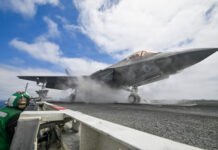



The United States has informed its NATO allies that it plans to gradually reduce the number of strategic military assets dedicated to the alliance, including bombers, fighter aircraft, drones, submarines and warships, as Washington intensifies pressure on Europe to assume greater responsibility for its own defense.
The announcement was delivered during a closed-door meeting of NATO policy directors on Friday by Pentagon adviser Alexander Velez-Green, according to two alliance diplomats who spoke on condition of anonymity in order to discuss the confidential talks.
The planned reductions form part of a broader and long-running effort by U.S. President Donald Trump to scale back America’s role within NATO, which he has repeatedly criticized as disproportionately benefiting European countries at Washington’s expense.
The move also reflects the administration’s broader strategic reorientation toward other regions, particularly the Indo-Pacific, where the United States increasingly views China as its primary geopolitical challenge.
Although American officials emphasized that the drawdown would be coordinated with allies rather than carried out abruptly, the prospect of reduced U.S. military capabilities in Europe has nonetheless raised concerns among NATO members that remain heavily dependent on American assets for deterrence, intelligence and rapid-response operations.
Jennifer Kavanagh, director of military analysis at the Washington-based think tank Defense Priorities, said the withdrawals would leave capability gaps that European allies could struggle to replace quickly, especially in areas requiring highly specialized and expensive systems such as submarines and long-range strategic bombers.
However, Kavanagh argued that Europe should avoid attempting to replicate American capabilities on a one-to-one basis. Instead, she said European governments should focus on developing the military capacities most relevant to defending the continent independently.
“The important thing with these U.S. withdrawals is not that Europe matches what is lost but that Europe figures out what it really needs to defend itself and procure those capabilities,” Kavanagh said. “Across the board Europe can do this within five years.”
Secretary of State Marco Rubio also acknowledged on Friday that further American troop and weapons reductions in Europe were being prepared. Speaking to reporters in the Swedish city of Helsingborg during a meeting of NATO foreign ministers, Rubio stressed that allies had already been informed and consulted about the process: “It’s well understood in the alliance that the United States troop presence in Europe is going to be adjusted — that work was already ongoing, and it’s been done in coordination with our allies,” Rubio said. “I’m not saying they’re going to be thrilled about it, but they certainly are aware.”
NATO officials themselves framed the planned changes as part of a broader transformation already underway within the alliance, as NATO spokesperson Allison Hart told POLITICO that European countries and Canada had become overly reliant on American military capabilities over the years, but said that imbalance was now beginning to shift as allies increase defense spending and expand their own military capacities.
“There has been an over-reliance on U.S. forces and capabilities,” Hart said. “But as Europe and Canada are investing more in defence and developing more capabilities, the balance of responsibility can shift.”
She added that the transition could ultimately strengthen NATO’s long-term defense posture by reducing dependence on a single ally and encouraging a more balanced distribution of military responsibilities across the alliance.
“This change strengthens NATO’s defence plans by reducing over-dependence on one ally and is a reflection of a broader shift happening within the alliance,” Hart said.
The announcement comes amid growing debate within Europe over strategic autonomy and the continent’s ability to defend itself without overwhelming American support.
Russia’s attack on Ukraine has accelerated defense spending across Europe, but many NATO members continue to rely heavily on the United States for key capabilities ranging from missile defense and airlift capacity to intelligence gathering and nuclear deterrence.
Why is NATO not pushing back aggressively against the planned U.S. military drawdown? Because the situation does indeed highlight a core contradiction of the alliance: that NATO is formally an alliance of equals, but materially it has been deeply dependent on the United States for decades in ways that are extremely hard to unwind quickly. Many European governments privately acknowledge that the United States has carried a disproportionate share of NATO’s strategic burden for decades. At the same time, European leaders fear that openly confronting Trump could trigger an even sharper American withdrawal, so their strategy has largely focused on avoiding public conflict while gradually increasing defense spending and developing more independent capabilities. NATO also wants to avoid projecting disunity at a time of heightened tensions with Russia, since visible fractures within the alliance could weaken deterrence. As a result, the response has been cautious and managerial rather than confrontational, with allies framing the shift as a “rebalancing” of responsibilities rather than a crisis. The real problem, then, if this is all talk – “bedtime stories”, as Romanians would say – given that many European states still lack the ability to rapidly replace key U.S. military assets.
