












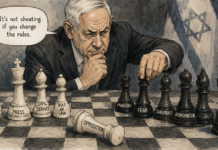


Vanessa Seyman, one of Israel’s top negotiation experts, thinks so
Sixteen months into the Middle East war, negotiations grind on – now for the second stage of the Gaza ceasefire. The fate of scores of hostages remains unclear, Hamas is battered but still standing, Gaza is devastated, and Israel is still searching for a long-term strategy beyond military operations. Ceasefire talks have been slow and fragile — and now Donald Trump has thrown out one of his signature wild proposals: depopulate Gaza and move its people elsewhere. Everyone is up in arms. No one has a clue.
But this much can be said: Decades of negotiations have not been a spectacular success. Not only is there no grand vision for peace between Israelis and Palestinians – even less ambitious goals end up mired in quibbles, mulishness, myopia and grandstanding. This is widely attributed to a cultural disconnect, and to the complexity of the problem at hand. But could it have to do with the fact that almost all the negotiators – indeed, at this point absolutely all of them – are men? That’s a little strange, isn’t itSS?
Vanessa Seyman, one of Israel’s top negotiation strategists, thinks the answer may be yes. Seyman, who has advised both public and private sector clients at the highest levels including the Israeli government, argues that female negotiators bring a different and necessary perspective. She notes that Research shows that women tend to be more focused on relationship-building, long-term strategy, and emotional intelligence — qualities that are critical in diplomacy but undervalued in Israel’s security-first culture.
Seyman told me that while male-dominated teams may excel in high-pressure, one-off dealmaking, they are less effective in managing complex, long-term conflicts where resilience and flexibility are essential. Noting that Israel’s negotiators are overwhelmingly men of military background, she argues that a more balanced team — including women and other groups — would approach negotiations not just with strength, but with savvy and vision.
We sat down at a Tel Aviv cafe for a drink and a conversation.
Dan Perry: The negotiations between Israel and the Arab side since October 7th have been run by men. Why is this – and is it good, bad or indifferent?
Vanessa Seyman: First of all, it comes from the deep conception that dealing with the Israeli-Palestinian conflict is a security issue. Israeli society relies a lot on ex-military people and because of that we give a lot of value to military savoir-faire. In the military arena most of the generals are men. Now they’re jumping into the geopolitical and this is a big no-no. If you are brought up in a military world, if your milieu is always a military one, naturally your endgame will have a military aspect.
DP: Are men less likely to achieve a breakthrough or out-of-the-box thinking or show sensitivity to the other side? Would it be better if the negotiating team was 50-50 like society? Would it be better if it was all women? Is there a fundamental difference between men and women?
VS: Definitely. If you talk about outcomes and perspectives it was proven over and over again in past research, in Linda Babcock’s “Women Don’t Ask” for example, that women negotiate much better for others than for themselves. Males are great negotiators for themselves, they’re putting themselves on the top of the pyramid. As Carol Gilligan said back in the 80s, with women negotiation sits in the “heart of the net.” This perspective, of being at the head of the pyramid or in the heart of the net, is in fact the main difference when it comes to diplomatic negotiations. Do you put your opinion first or do you make decisions after consultations with content experts? Women will generally listen first – we’re mothers and it comes because of the fact that we need to take care of others, it’s even prehistoric and has nothing to do with the modern time. This is not the default when it comes to male thinking. It’s not always, but the inclination is that way.
DP: Is it always better?
VS: It depends what kind of negotiation we have. If it’s a one-time deal with a beginning and an end, let’s say you bought a house or sell your car and you don’t have any implementation or long-lasting relationships with the other side, then male characteristics are very effective, doing their show, spreading all over the place their peacock feathers, and done deal. While when you are negotiating a business relationship, a geopolitical relationship, as with Israelis and Palestinians who are neighbors, men would be less likely to think ahead about how to maintain good neighborliness, without harming essential interests. And by the way, the Israeli government doesn’t think about the day after scenarios because they are still in the position of reckoning with Hamas for what they did. So, are you thinking tactically or strategically? Tactical-wise it’s very important to have male characteristics in negotiation: sitting around the table putting a very serious and severe face, putting my foot down and appearing very, very, very angry. Women are less good there. But if we are thinking about the long-term endgame of where we want to be, you have to think trade-offs. You have to think: What am I willing to give? This is the place where women negotiators are much better, thinking long-term. Many times a woman will say to herself I will compromise on the here and now just in order to gain more points, more emotional leverage, so that he will feel that he owes me for the future. Now, this is a strategy that the state of Israel needs.
DP: So if the negotiation team was less unbalanced there might have been an approach more conducive to easing the Palestinians away from support for Hamas and moving Hamas aside in ways that are emotionally intelligent?
VS: Let’s distinguish between negotiating and managing negotiation. The Arab world perceives women as weaker, and it’s not only the Arab world, so you also need to think about not the team at the table but who is behind the scenes managing the process. The decision making of the government should be run not only by ex-military men – I would like in the cabinet religious people, philosophical and social people, psychologists also, people who will help us to end the conflict once and for all in a way that everybody can put it behind them. A lot of our people now will say “they want us dead.” And in this perspective, I as a woman will say “you want me dead, Hamas, you will not have me dead, now let’s talk.” This is something that men negotiators are not so likely to do. They say ”If you want to kill me, I’ll kill you first.” And this is the difference. I’m able to sit on the table with a person I deeply dislike and communicate.
DP: Is there something deeper to this?
VS: Definitely. First of all, the proactivity, in three aspects. Women are proactive otherwise they won’t have a place around the table. So women would have thought about the day after. Maybe you wouldn’t like the result of that day after but we’ll talk about options that we don’t like. Second, wanting the world to tell them they are right, you are the good guys – women don’t need that, we don’t need to feel that we are ok, we are pragmatic. You are my boss, I need to get something out of you, I will put it aside and I will talk to you although I dislike you. Third, you are able to see on a person’s face what he thinks about you from the moment he entered the room especially in the Middle East. I will say women are much better again – I’m generalizing of course – but we tend to be much better in managing our emotions and being able to be pragmatic and instrumental therefore being smart and not only right.
DP: So we might not have gone through a year and 3 months in which basically nothing was achieved at the negotiating table – until Trump insists?
VS: Exactly. We didn’t give any proposal. We didn’t have any initiative of our own. Zero proactivity.
DP: And this basically is because of the male ego and the desire to tackle everything by force and the preference of tactics over long- term thinking?
VS: Males in the Middel East are educated to be strong, show strength, show aggressiveness and not be perceived as weak. And in a negotiation, women learn to use weakness as a tool in achieving things.
DP: Isn’t it a little bit dangerous to speak of qualities that are attached to men and women? I understand you’re not saying it’s 100% but rather correlations and statistical probabilities. But isn’t there a danger that if we decide that women are overwhelmingly one way or another the conclusion might therefore be well, then they shouldn’t be in places X, Y or Z?
VS: Everything that you take to the extreme is dangerous. A doctor who learned years in order to be a good practitioner and do a good diagnostic learned statistics – but if you come to him with a headache and he says 80% of headaches are only dehydration and you can go home – would you be happy with that doctor? No, because you want him still to check you up, right? Statistics are important but it’s not the only thing. So I use statistics in order to make better decisions that countries need to do. Maybe a man will have the female negotiation style – so we need always to adjust the generalization to the specific person. Don’t let stereotypes rule the day but also don’t ignore reality. And oh, yeah, we gave males enough chances, right? Now it’s our turn.
