











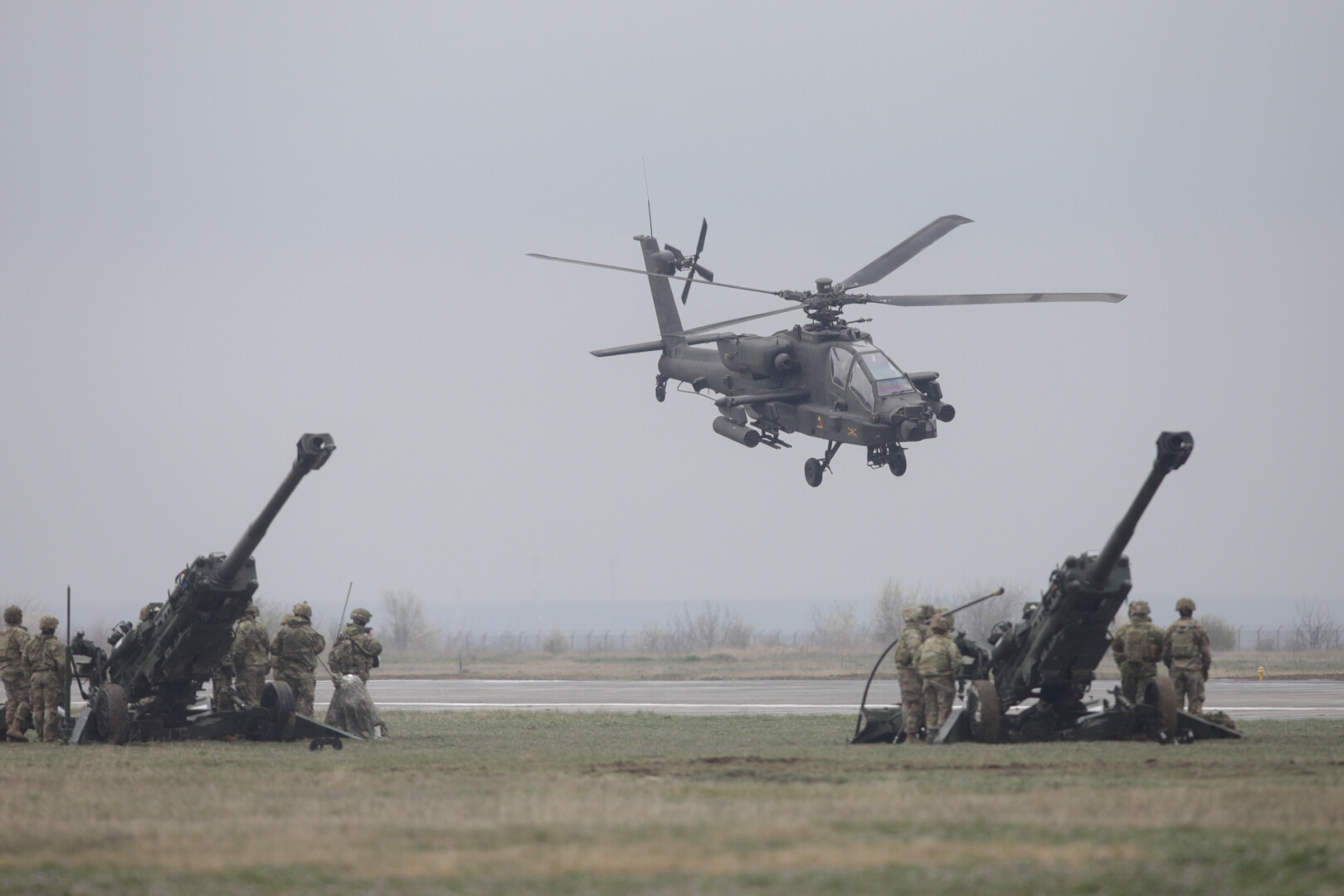
The recently announced departure of hundreds of American troops, a new decision from the Trump administration, “does not represent a withdrawal of the United States from Europe nor a signal of a decrease in commitment to NATO and Article 5,” the Pentagon said reassuringly.
According to the same source, the episode in question will not change the security environment in Europe” and, moreover, it can be taken as “a positive signal of increasing European capacity and responsibility”.
It is true, Washington’s decision, however indigestible for Europeans, is not in itself one likely to contradict the Pentagon’s communiqué in any of the essential points mentioned above.
It should also be noted that the official positions taken in Bucharest reflect, broadly speaking, the same narrative (but it is also worth noting that the officials in Bucharest, like their counterparts in other European capitals, have the titanic task of weighing their positions in order to avoid harming the transatlantic relationship).
At the same time, the move made by the US is not entirely surprising, given that signals from the Trump administration for several months have indiicated that he will come to such a decision.
Donald Trump has never made a secret of his burning desire to see fewer U.S. troops in Europe and to see more European troops take over a significant share of what the U.S. leader considers to be a liability rather than an asset to his country.
And yet, there is a not very constructive dimension to the decision taken by the Americans, which include the following:
- The fact that it comes at the worst time for the continent – in which the Russian-Ukrainian war is continuing, it hasn’t ended and the Russian threat is famous for its loose attitude towards borders.
- The fact that it comes at the worst moment when the transatlantic relationship is also at its worst – a growing deficit of confidence in the US’ willingness to respect its historic commitments to its allies; extreme trade tensions between the US and the EU; a massive ideological clash between the current leadership in Washington and the liberal governments in European capitals.
- The fact that it comes at the most tense moment recorded in the hybrid war waged for years by Putin’s Russia against the West. And in this context, the US decision on the withdrawal of those troops will rather fuel hostilities on this front, as it provides plenty of ammunition to Russian propaganda whose target is precisely the creation or exploitation of fault lines between allies.
- The fact that it comes at the worst time for liberalism and democracy in Europe. Of course, it is desirable and pure logic for European states to help each other, to increase security, and to do so infinitely more and boldly than they had been accustomed to. But what sounds good on paper sounds quite problematic on the ground, given the rise of populist forces on the continent (of which neither Putin nor Trump are strangers to), the so-called ‘sovereignists’, forces that push for less reciprocity, for a relaxation in the relationship towards Russia and, in general, less interaction with Europe.
- The fact that it is happening just as the White House begins to put pressure on Russia to get Putin to enter into real negotiations to end the war in Ukraine. This aspect was underlined by the extraordinary position of two Republican congressmen who “firmly oppose” the Pentagon’s approach regarding American troops in Romania. One heads the U.S. Senate Armed Services Committee, and the other the relevant House Committee – details SEE HERE.
In Bucharest, President Nicușor Dan’s initial reaction was balanced, underlining the good parts that remain (and, basically, there are enough good points not to cause panic). However, the head of state noted that “by resizing the rotational force that operates in Romania, the presence of American troops in Romania actually returns to the level before the war in Ukraine” (my emphasis).
And precisely in this (the final part, which I have underlined) lies the main crack in the logic of the Trump administration: from the perspective of Europe’s security, Moscow’s deterrence, the responsibilities assumed by the US and the strategic interests of the US, it follows that it should not change anything that the same number of American troops that had existed during the peace stay in the midst of a war waged by Russia on the continent, the same number as before the outbreak of hostilities.
This kind of arithmetic is, of course, familiar to us since Donald Trump returned to the White House. But the simple fact of being accustomed to the unusual cannot compensate for the inadequacy of unusual measures.
Moreover, the nine months of Trump’s term in office were marked by lamentable miscalculations by the Washington administration regarding the nature of the Russian aggression in Ukraine and the intentions and plans of the Russian dictator (in Ukraine and the rest of Europe).
The fact that such mistakes existed was acknowledged by the US president himself, every time he complained about Putin’s attitude, every time he said that he had expected the war in Ukraine to be the easiest conflict to resolve among the existing ones.
Even if the new move made by the Pentagon, under the baton of the US president, is presented by the American side as a positive fact for the US security posture and even as an opportunity for Europeans to take their security into their own hands, the suspicion that we are witnessing a new miscalculation on the part of the Trump administration, related to the Russian threat, it is solid and ubiquitous.
After all, less America in Europe is exactly what Vladimir Putin has been aiming for, by all means, since the day he took office in the Kremlin.
And since Donald Trump reinstalled himself in the White House, the truth is that the Putinist idea of “less America” has become a trend: after January 20, in Europe, there began to be less America from the perspective of values, less from an economic perspective, less ideologically, less from the point of view of soft power. From Wednesday, and a little “less America” from a military perspective.
- PS: It is no coincidence that the Putinists on the Romanian political spectrum (and not only in Romania) are generally crazy about Trumpism and Donald Trump.
U.S. Remains Committed to Romania, U.S. Ambassador to NATO says after troop withdrawal announcement
