






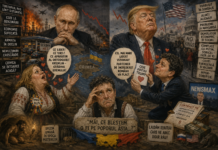

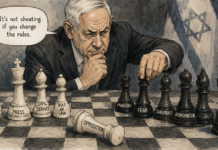




The Trump-Zelensky meeting in the Oval Office was a success in that it was not a failure and allowed for a transition to the later phases of the talks.
The discussions, which followed, where other European leaders “escorted” their counterpart from Kyiv to Washington, were a public success if they are judged in terms of their focus on the following: the significance acquired by the topic of security guarantees for Ukraine, avoiding focusing on the pressure of dangerous territorial concessions in favor of Russia, as well as by the fact that they left behind a relatively cordial atmosphere between the old European and American allies, thereby creating space for new developments.
The fact that at the end of the White House meetings, Putin is under pressure to accept a meeting with Zelensky, again adds a constructive element to the still fragile foundation of peace negotiations.
Without minimizing the American efforts, it is worth emphasizing, however, the effective mobilization of Europeans in the direction of shaping Trump’s approach, strengthening Ukraine’s posture and diminishing the margins of maneuver that Russia still has.
Of course, everything – both for better and for worse – can still be expected or imagined, regarding the evolution of the discussions between the parties committed to stopping the Russian-Ukrainian war.
But perhaps one of the precious gains at the end of Monday is related to what Donald Trump himself was able to see with his own eyes: despite its virile appearance, the Kremlin is a long way from having a monopoly on having the last word. Russia is not in a position to advance its pawns as it wishes; Moscow has neither enough military force nor the necessary diplomatic arguments to dictate or write the draft of the peace agreement on its own terms (let alone force Europe and the US to accept it in such a form).
It’s hard to believe that Donald Trump, at least thanks to the intuition he developed as a businessman, didn’t immediately notice this detail that could betray Putin’s shadow game. And it is even harder to believe that European leaders did not preemptively draw his attention to the permeability of Russia’s position and posture.
Another precious gain is that Trump himself could also see that the fact of having accepted the Europeans’ assistance in the White House negotiations was conducive to making at least some progress in softening Russia, therefore in making progress in the peace talks, as such and in building a rather positive perception of his efforts to bring peace.
Again, it is more than likely that European leaders did not miss the opportunity to help him, preventively, to open his eyes to this reality as well.
Alone in the face of Russia, it will be impossible for Trump’s America to impose on Putin the pace and background desired by Trump, in order to advance authentically on the path of peace.
This truth can be deduced from the course of things while Trump had shown hostility towards the involvement of the Europeans.
This can also be deduced from the fact that it was no less difficult for Washington, for months on end, to make a much thinner actor bend to its liking, with fewer cards in his hand than Putin’s Russia – Zelensky’s Ukraine.
Europe therefore has a major role to play in the evolution of Russsian-Ukrainian peace negotiations. Of course, this should not be overestimated, but in no way should it be underestimated.
The smarter, more appetizing and more convincing this aspect is sold to the American president, the more effectively the offer from the Russian dictator will be reduced.
The minimum that Trump can do for a just and lasting peace in Ukraine will always be greater and more substantial than the maximum that Putin could ever do.
I have underlined this point in the past (see this link – HERE) that in order to shape the path to peace and peace itself, it is vital that Ukrainians and Europeans focus on Trump’s strategy and impulses, their attention to Putin’s strategy and impulses are only relevant from the perspective of keeping the course of the war under control.
Trump, and not Putin, is the key to the success of the Europeans’ efforts to achieve peace, from the Europeans’ perspective, while Russians are not the key for Trump’s efforts to crown himself peacemaker king in Ukraine.
The quicker and clearer the Americans and Europeans will understand the validity of this synergy and interdependence, the quicker and clearer the Ukrainians will understand this paradigm, the stronger and faster the Russians will be pushed into the corner of the ring where they are waiting (still unnoticed by the boxers) for a truly productive peace agreement.
We recently headlined (link – HERE) that “At the White House, Ukraine and its allies either get snatching peace from Putin, or there will be no peace anytime soon.”
The key in which we deciphered what happened on Monday at the White House suggests that more or less timid steps have been taken in a promising direction.
The stake, now, resides, from the perspective of Europe and America, in becoming aware of the nuances, preserving the gains, adapting the rhythm and unleashing even more courageously both the potential of the imagination and the generous reservoir of resources.
