

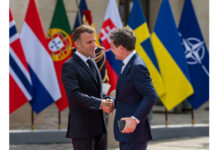
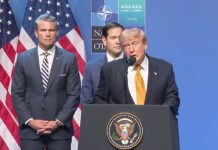




The statements made on Wednesday by the leaders at the B9 Summit in Bucharest were precise in their diagnosis and offered clear guidance.
With the notable exception of Hungary, in the midst of a transition from a pro-Russian to a pro-Western regime, the countries at B9 format are in no doubt regarding Russia’s actions and intentions, have no doubts about Ukraine’s key role in the new security architecture, and no hesitations regarding the necessity for regional and North Atlantic cohesion, They have long-term response plans to current challenges and say they have the political will to turn them from paper into reality.
On a positive note, NATO Secretary General Mark Rutte even insisted regarding the US: “It is clear that everyone is trying very hard to go get to that 5%. Some countries are accelerating and even exceeding 5% and will get there by 2035. The U.S. sees and understands these things.”
Polish President Karol Nawrocki, was right to remark that: “The B9 is more important today than ever in its past. We are not on the sidelines here, but a center of gravity of NATO.”
The final Joint Declaration made some key points:
- “United in the face of profound security threats and challenges, especially the long-term threat posed by Russia, we continue to intensify our contributions to our collective defense. We are taking on greater responsibilities by increasing burden-sharing and increasing investment in defense.”
- “NATO must focus on the fundamental task of collective defence, including through a robust forward defence posture. We remain committed to ensuring that NATO’s defence plans are fully resourced.”
- “We welcome the Baltic Sentry and Eastern Sentry initiatives, which strengthen our position, as well as the Arctic Sentry, which represent a step towards a stronger and more persistent NATO presence in the Arctic.”
- “Further expanding the transatlantic defence industrial base, including through increased production capacity, more resilient supply chains, efficient multinational procurement, sustained investment in research and innovation, and building on lessons learned from close cooperation with Ukraine, is essential to meet current security challenges.”
- “The pressure on Russia to end its illegal war of aggression and to engage meaningfully in peace negotiations must be increased.”
- “We are united and ready to continue to ensure a more combat-capable, resilient and better prepared Alliance, always ready to defend every inch of Allied territory.”
If we look at the B9 Summit through the angle relevant to us – Romania has a troubled history, and geographically it is in an inescapably dangerous region, close to Russia. We can conclude that we are the lucky generation, because Romania has allies, and is of interest to them, that it finally has reasonable prospects even if the geopolitical moment can be catastrophic.
It is even a generous to no longer be alone or isolated, and for more than two decades we have been protected by two walls- a security community (NATO) and a community of values (freedom, democracy, rule of law, market economy) (EU).
But while there are many reasons for a sense of strategic comfort after the B9 Summit, there are also reasons for a critical self-assessment.
The contrast between the foreign policy offered Wednesday in Bucharest and what Bucharest’s domestic policy is offering is striking.
For Romania, the B9 is a feeling of strategic comfort. However, the diagnosis made by leaders on challenges and threats, as well as objectives and response plans, delivers a single message: there is no room for internal divisions. No country can have an adequate foreign policy without a corresponding domestic policy.
Romania stands out here.
The B9 summit in Bucharest took place during a complicated political crisis, with an interim government and a background of polarization that may get worse in certain circumstances.
The following intentions and commitments were reiterated at B9:
- Sustained economic effort (e.g.: increasing spending, but also creation of new industrial capabilities in the defense sector plus expansion of existing ones).
- Sustained political effort (for example, an adequate level of understanding and cross-party cohabitation, but for this it is needed, above all, elementary political stability).
- Sustained social effort (for example, it is essential that the population is made to understand the purpose and extent of the labor that awaits them).
The lion’s share falls to the parties, the government, the president in these three categories.
But what stands out in Romania right now is the failure of the three main actors.
What could be more symptomatic from this point of view, and in sharp contrast to the spirit cultivated at B9 is the fact the summit was taking place in Bucharest, while (also in Bucharest) the SAFE program, a key piece of the European plan to respond to the Russian threat, was being battered?
How?
By challenging the hastily issued ordinance at the Ombudsman and possibly the Constitutional Court. The consequences will discredit and possibly the delay of the SAFE program, on its Romanian segment.
The SAFE case is, moreover, a clear illustration of how indiscriminate domestic policy can undermine the foundation of inspired foreign policy.
It is useless for Romania to be among the biggest beneficiaries of the European defense initiative, if it faults by itself.
There is, of course, an example of good practice, Poland, the other major beneficiary of SAFE.
What a contrast! While Warsaw is already starting to sign contracts, Bucharest is starting to self-sabotage. While domestic politics aren’t clear for the Poles, warring political camps seem to understand that they should not allow themselves to harm the national interest.
For Romania 2026, the lesson is simple, but telling: it is useless to have either allies or perspectives, if you either don’t know how to take advantage of them, or you simply make fun of them systematically.
