



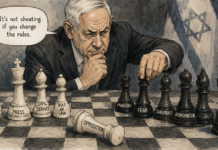


The fact that Moscow’s sharpest geopolitical arrow has been removed from Romania’s presidential elections will be seen by them as a major and unexpected failure.
But the problems posed by Russian interference in the Romanian electoral process have not gone away. For Moscow, withdrawal is not an option. And if backing off isn’t possible, then regrouping and counterattack are its most likely tactics.
The reason why Russia thinks in these terms is simple: despite the setback of “Operation Georgescu”, the Kremlin still has one card to play: the active electoral capital it won using Calin Georgescu.
What the Russians intend do now is to manage this capital, so that by the runoff on May 18 it increases this capital, and Moscow will collect its long-awaited profit.
How can it do this? Classical methods:
- By escalating the information war (abusively using social media, spreading key talking points of Russian propaganda, exploiting flaws in Romanian society, demonizing the EU, promoting criticism of Europe and Romania, coming from the Trumpist area, massively disinforming, etc.).
- Betting on another candidate capable of taking the baton from Călin Georgescu.
For the first point, it is clear that the Romanian state must show a maximum level of vigilance, and afford to repeat previous mistakes. Authorities must be proactive and aggressive where necessary, even with the slightest external attempt to disrupt the atmosphere in the country and alter the electoral process itself.
Of course,the general public also need to open their eyes and minds wide to be aware of “information” designed to manipulate them. However, the state must play a leading role, given that its institutions have the right experience, know-how and tools to see beyond appearances, but also to press the shut down buttons, when necessary.
As for the second point, things are reversed.
Even if the state retains some elements in terms of monitoring the overall situation, most of the mission will fall to the Romanian voters, who have the opportunity to judge not only what the candidates will tell them, but also who these candidates are, what they have done so far, what kind of positions they have defended in the past on the relevant issues, What kind of positions they defend now, who is in their entourage.
For Russia, to tap into the electoral capital it secured during “Operation Georgescu”, it will have a favorite or more than one favorite.
A key question is: Who is that or those candidates ?
Personally, I think that two names qualify for Russian to redirect its support from Călin Georgescu to a new horse/horse. But there are other figures as well.
One would be former Prime Minister Victor Ponta, as seen by his past and present actions.
The past recommends Ponta through his relationship with (former prime minister) Adrian Năstase as his former pupil”, to whom he owes at least partially his career and meteoric to the top of the state apparatus.
Adrian Năstase, the corrupt former prime minister who was always angry with the West.
Adrian Năstase, the the one whose foundation (what an irony, its title: Titulescu European Foundation) has been constantly welcoming with influential figures from Putin’s Russia.
Putin’s super aggressive ideologue, Alexander Dugin, and others were welcomed by the foundation with open arms, in recent years. The environment there was a mix of anti-European and nationalist ideas. I would like to recommend a long read published by Revista 22 exactly six years ago on these topics. You can find it HERE.
Ponta launched the slogan “Proud to be Romanians”. He did it 10 years ago, long before the emergence AUR party that espouses Putin’s sovereigntist type idea. What’s interesting is that all this happened immediately after the annexation of Crimea, at the time of 2014 European Parliament elections. In addition, it is “coincidentally” one of the central themes that Moscow has massively exploited in all EU countries, in the years that followed. It is a theme that has been exploited by Russians in their attempts to create a hostile attitude in EU countries to Brussels, which is, the mortal cultural enemy of Putin’s Russia.
Let me stop here , leaving you this article I wrote HERE immediately after the 2024 parliamentary elections.
At the same time, Victor Ponta is eligible for Russian support in his campaign due to other channels, namely China (he is one of the best connected Romanian politicians to Beijing), Serbia (where his friend, the fugitive Sebastian Ghita, is located), and also Turkey. All these three countries are in a complex love relationship with Russia.
The above elements are related to Ponta’s past, which may awaken Russia’s appetite for Ponta.
In the case of the former prime minister, however, there is also an up-to-date dimension, which would make him Moscow keen to promote his candidacy.
Even before the elections were canceled, he was promoting Călin Georgescu. And after the annulment of the elections, perhaps also anticipating Romania would not accept another attempt by Călin Georgescu to run for president (because Ponta is not just a pretty face, but is smart boy and well quite connected), Victor Ponta began to imitate Călin Georgescu.
From this point of view, Victor Ponta is a fierce rival to the more traditional nationalist, George Simion.
Last but certainly not least, with Donald Trump’s victory in the US elections, Victor Ponta has been building a profile of being a thoroughbred Romanian Trumpist, which has probably made the political trailblazer and scholar whose moral positions have a tendency to change, one “Mike” Neamțu (now an AUR parliamentarian), jealous.
We also know that George Simion was disturbed by Victor Ponta’s Trumpist offensive.
Simion who also wants to be part of the Trump ecosystem is in fierce competition with Ponta: “He has no direct contact, as you have seen, with the Trump family,” Simion said tetchily of Ponta. “We don’t have time for losers and people who will crawl over dead bodies tonight.”
But the truth is that Ponta, probably helped by various friends, had various photo opportunities or quick meetings with a number of famous Trumpists – from Donald Trump’s eldest son to Trump emissary, Richard Grenell.
Finally, Victor Ponta, who commented on Trump’s victory, urging Bucharest to quickly and unequivocally get on the Trump train that is resetting the global order.
Placed in the context of the warm Trump-Putin relationship, it is clear that Russia cannot fail to consider support for Victor Ponta. With the new electoral terrain in Romania, the Ponta variable is of logical interest for Moscow’s constant interference.
Another vector for the Kremlin’s keen eye will be George Simion.
So much has been written about the Simion-Russia relationship, there are so many pro-Russian statements by Simion, by his AUR party that he leads. Simion has promoted all the topics on Russia’s agenda. In short, Simion supported Calin Georgescu until the last moment.
It remains unknown, but soon to be clarified: will George Simion’s candidacy be accepted or not?
The Central Electoral Bureau must study the files very carefully (the collection of signatures was done too quickly to not to arouse legitimate suspicions). The Constitutional Court must judge George Simion’s candidacy with great scrupulousness, given the Russian shadows in George Simion’s political and civic activity.
Finally, Moscow’s attention may be directed towards the lesser-known Anamaria Gavrila, the leader of the little-known, but nevertheless parliamentary party, POT.
If, in the end, she will be the AUR candidate for the presidency, Gavrilă will have problems as she’s not well known, has been attacked by Gigi Becali, compounded by the frustration of AUR members, other than Becali and Claudiu Tarziu (who have already been critical of her) will feel. Frustrations that for some are simple misogyny, while for others the fact that AUR was unable to field its own candidate, and for others these and other reasons.
Anamaria Gavrilă is politically and religiously, very Russian and anti-European. She has the endorsement of George Simion and is associated with the image and “values” of Călin Georgescu.
There are enough arguments for Moscow to take Gavrila into account, but since the devil is in the details, it remains to be seen which candidate the Kremlin considers most “eligible”.
I have left out another candidate, Anton Pisaroglu, because he’s an unknown. He was an adviser to Călin Georgescu, but only Moscow can weigh up whether Pisaroglu could be a viable arrow they can invest a lot in a rather short time.
What stands is that The Kremlin has lost its main pawn in the Romanian elections, Calin Georgescu. But what emerges if only from the above lines that it has not completely run out of potential pawns in the May presidential election?
It’s an art to win first time around, but it’s no less an art to retreat quickly and stage a fresh attack. For Romania’s sake, let’s hope that Moscow has a crisis of election meddlers.
