









The American president is haunted by the ghosts of America-1980 and France-1986
Tuesday, January 6, 2026, was an interesting day, as it marked the half-decade anniversary of one of the darkest days in the history of American democracy: the siege of the Capitol, fueled by Donald Trump’s refusal to admit defeat in the November 2020 presidential election and, as such, his refusal to hand over the reins of power.
But Tuesday, January 6, 2026, was a very interesting day as Donald Trump, re-elected president in November 2024, addressed the Republicans in a panic:
- “You have to win the midterm elections because if we don’t win them, they will simply – that is, they will find a reason to impeach me.”
At that time, although worried, Trump still felt he was on a wave; only three days had passed since a spectacular commando operation by the US army resulted in the kidnapping, directly from his bed, of the Venezuelan dictator Nicolas Maduro.
Of course, the concerns expressed by Donald Trump about the congressional elections and his possible disastrous fate in the event of a possible Republican failure, did not have to do with the Venezuela episode (it had been a resounding success), but very likely with:
- The modest return of his first year in his second term
- The controversies surrounding immigration
- The controversies he created with allies abroad, especially those in Europe
- The issue of punitive tariffs imposed on them and the specter of their removal by the Supreme Court (which happened, not long after the panicky speech of January 6).
But no less likely, Trump’s fears were also fueled by what he already knew at the time he was about to undertake: an extremely risky military adventure in Iran.
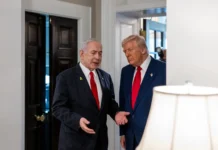
January 6 was just after Benjamin Netanyahu’s New Year’s visit (December 28-January 1) at the annual gala in Palm Beach, Florida.
Probably, on that occasion, the two friends significantly planned the Iran operation. In any case, Netanyahu visited Trump once more in mid-February, just two weeks before the US and Israel attacked Iran.
And last but not least, as the Israeli prime minister himself was quoted as saying, in the preamble to the mid-February trip, his seventh meeting with Trump since the he was re-elected president (seven visits in just one year, more than any other foreign leader!).
It’s highly likely that the two leaders discussed a conflict with Iran in those two meetings.
It’s probable that Donald Trump had the Iranian dimension on his mind when he called on the Republicans to win the elections.
America has waged war on Iran, and in doing so he has created ample grounds for impeachment should the Democrats gain control of Congress in November.
The prospect of the Republicans being dealt a stinging defeat at the polls is a big problem for Trump.
The Iran war combined with shortcomings of his first year in office may sway the election.
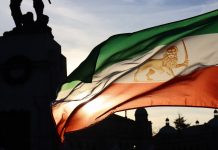
For more than 45 years, the theocratic regime in Tehran has used war and its younger brother, terrorism, as a bat with which it influences internal politics in the world’s great powers.
Iran managed to influence the 1980 US presidential elections and the 1986 French legislative elections.
It has the interest and experience to try for a hattrick in the US mid-term elections.
The only defensive system that Iran can afford today, in the current conflict with the US and Israel, is the asymmetrical one, in which under-the-belt strikes are not only allowed, but are vital. Tehran will most likely try to punish Trump by acting in such a way as to erode the Republicans’ chances at the polls.
It is probably no coincidence that the Houthi terrorist group, in Yemen, a proxy for Iran, which were inactive in the first month of the conflict, has just announced its entry into the game.
It did so when the resources of the US and Israel to sustain a war at maximum intensity were eroding, and at the same time when the US secretary of state was giving assurances, from a G7 meeting held in Paris, that the war would end in weeks and without US troops on the ground.
History groans with factual elements and revealing parables and it is now time to give it the floor.
How Iran weighed on the outcome of the 1980 US presidential election, when Jimmy Carter lost to Ronald Reagan; how Iran put pressure on the 1986 French elections which resulted in a difficult cohabitation between President François Mittrand and the new prime minister, Jacues Chirac.
As for November 2026 – who knows? – Perhaps Iran will also influence the outcome and help prepare the ground for a difficult cohabitation between Donald Trump and the Democrats.
America, 1979-1981
- At the beginning of 1979, a new regime was installed in Tehran: theocratic and profoundly anti-American, under the rule of Ayatollah Ruhollah Khomeini. On November 4, 1979, the US Embassy in the Iranian capital was stormed by radical students and occupied. 66 people were taken hostage, 13 are immediately released, but the rest remain captive for 444 days. The Carter administration is ravaged by this crisis in its last year in office and during the electoral campaign. The crisis is amplified not only by the fact that America is living 24/24 with 50 hostages in mind, but also by the fact that the Carter administration’s attempt to release them by force ends in an embarrassing failure. With an election year in the US and a broad anti-American mood in Iran, the Khomeini regime decides to tighten the screw and play electoral games in the US, managing to influence the outcome more than local voters. Presidential elections are held on November 4, 1980, but hostages are released on January 20, 1981, the day of the inauguration of the new president – Ronald Reagan. The release comes just minutes after Reagan delivered his inaugural address. Given the magnitude of the stakes (the White House), given the “coincidences” (the release of hostages immediately after the inauguration of the new president) and the saying that politics is a whore, it is not surprising that the October Surprise theory appeared and persisted for decades. According to this theory, the surprise in October was that Reagan’s entourage made contact with the theocratic regime, asking for the hostages not to be released before Election Day, so that Jimmy Carter could not benefit electorally. Subsequent congressional investigations did not prove this.
France, 1986
Here are some excerpts from French historian, Pierre Razoux, in his book, La guerre Iran-Irak, 1980-1988.
It should also be noted that, on March 4, 2026, this Middle East expert was invited by the Senate Committee on Foreign Affairs to present an analysis of possible scenarios for the evolution of the current conflict in the Gulf.
This is what Pierre Razoux wrote in his book about the French legislative elections of 1986, in the middle of the Iran-Iraq war, and about the game of influence played by Tehran in Paris.
- To complicate matters, several intermediaries mandated by the RPR, then the main opposition party, had rushed to Lebanon to Iran a few weeks earlier to negotiate the release of the hostages, without the slightest consultation with French authorities. If Roland Dumas is to be believed, an envoy of Jacques Chirac would have outbid the offer of the socialist government and would have asked the Iranians to suspend negotiations until the results of the legislative elections were announced.
- Eric Rouleau, the special envoy to the President of the Republic in Tehran, sends François Mitterrand an explicit diplomatic telegram: “The opposition has been in close relations with the Iranian government for three months (…) promising him a much more advantageous agreement than the one offered by the current government. The opposition has warned the Iranians against any agreement that would enhance the current majority in the eyes of French public opinion on the eve of the elections.
- Jacques Chirac would later admit, on Europe 1 (January 6, 1987), that he had indeed tried to make a small contribution to this affair, even before he was in government. Akbar Hashemi Rafsanjani would drive the nail in even further, declaring in Jeune Afrique (July 19, 1987): “I confirm that the French right had indeed sent us a personality to Tehran to negotiate with us, before the French elections of March 1986.”
- This cacophony is not likely to facilitate the release of hostages, on the contrary. The Iranian government is naturally taking advantage of this damaging context to raise the stakes. Just a few days before the French legislative elections in March 1986, a television crew from Antenne 2, consisting of Philippe Rochot, Georges Hansen, Aurel Cornea and Jean-Louis Normandin, was kidnapped in the middle of Beirut. In the Hezbollah prisons they are joined by two other Frenchmen (Marcel Coudari and Camille Sontag). At the same time, Islamic Jihad announces the execution of Michel Seurat, kidnapped the previous year from the Lebanese capital. It will later be proven that the Shiite terrorist decline would only have managed to mask the natural death of the French researcher.
It should be noted, in parentheses, that the sound engineer Aurel Cornea, mentioned in Pierre Razoux’s book, was of Romanian origin and was married for a time to Aurora Cornu, the first wife of the writer Marin Preda.
It should also be noted that the attacks related to Iran continued in France and immediately after the legislative elections, the very next day, on March 17, 1986, plus three days later, just when Jacques Chirac took office as Prime Minister.
Strongly pushed from behind, Franco-Iranian relations are therefore advancing towards détente, from the perspective of the new government; On May 22, the new Prime Minister, Jacques Chirac, was already receiving his counterpart from Tehran in Paris. But later, some of the deals made with the Iranians by Chirac’s right-wing government were rejected by left-wing President François Mittrand.
But these are French domestic political issues, from four decades ago.
Today, what is more interesting is how American domestic politics will evolve, in the Trump era, still under Iranian influence, in the next nine months.
