












THIS DAY IN HISTORY: “I am not a crook,” declared Richard Nixon – and 52 years after that Nov. 17, his successor doesn’t even bother to hide it
Richard Nixon, cornered by the slow grind of Watergate, stood before reporters in Orlando on Nov. 17, 1973 and delivered one of the most iconic lines in presidential history: “I am not a crook.” It seems quaint to remember such a time, when a U.S. president accused of wrongdoing felt the need to insist on personal innocence. Compare this to today.
Donald Trump hardly even bothers to pretend that the presidency is not a personal enrichment scheme, and seems to revel in the indifference this commands. Corruption is not only not disqualifying, but hardly even interesting. Foreign governments, donors and business interests all circulate around a presidency, buying and selling.
Join our community! To support the defense of democracy and reason, unlock full access to Ask Questions Later by upgrading to a Paid Subscription (unless you have
Trump’s first term was the prototype — a demonstration that the presidency could be used as a funnel for private enrichment as long as the public could be distracted and the opposition overwhelmed. The Washington Post documented that the Secret Service alone paid as much as $650 per night for rooms at Mar-a-Lago, as well as tens of thousands of dollars per month for cottages at Bedminster. Over his presidency, Trump’s properties collected over $900,000 in taxpayer-funded payments just to host his security details.
Trump visited his own properties constantly — far more than any modern president visited personal holdings. Every trip required security, lodging, communications setups, transportation, and staff. And at Trump properties, those costs went to Trump.
Then there were the foreign delegations, donors, and lobbyists who understood the transactional landscape and acted accordingly. Whether seeking influence, face time, or goodwill, they booked rooms at Trump hotels, held events at Trump resorts, and in some cases directly advertised that doing so was a path to access. The most brazen example, of course, was Trump’s proposal to host the 2020 G7 summit at his own Doral golf club — an extraordinary plan he only abandoned after bipartisan outrage.
The practice resumed instantly in the second term: nearly $100,000 spent at Trump properties in the early months alone, plus more than $1.4 million in perimeter-security contracts around Mar-a-Lago since mid-2024. Republican political committees likewise continued to treat Trump’s businesses as party headquarters in exile. Within months of the 2024 election, GOP entities spent $676,000 at Trump venues, eventually topping $931,000 by the spring of 2025.
But all that was merely the first-term template. The second term features a massive international upgrade.
In the Middle East, where Trump’s diplomacy and his family’s business interests have become openly intertwined. Trump-branded real-estate projects have proliferated across the Gulf: Trump Tower Dubai, the Trump International Golf Club Oman, a Jeddah tower, and new luxury villa developments threaded through high-value Gulf real estate. These projects run through firms like Dar Global, a Gulf developer that paid the Trump Organization $21.9 million in licensing fees in 2024.
While this is happening, Trump is shaping U.S. policy while these same governments — and their sovereign funds and construction giants that are pouring money into his brand. The most brazen example is Jared Kushner, who serves as Trump’s informal but decisive adviser on Middle East matters while simultaneously managing a private-equity empire financed largely by those same governments. The assets under management for Kushner’s investment company Affinity Partners skyrocketed 60% over the past year to $4.8 billion, according to a regulatory filing, partly due to cash from Middle East investors including Qatar’s sovereign wealth fund. The fund then helped execute a multibillion-dollar acquisition of Electronic Arts alongside Saudi-backed partners.
At home, Trump has created an equally potent domestic enrichment engine. The super-PAC MAGA Inc. —despite Trump being term-limited — raised about $200 million over the past year. A meaningful portion of these donors have benefited directly from regulatory relief or pardons. Crypto firms facing SEC scrutiny saw investigations stall, high-dollar donors later received clemency, and more. None of this is hidden. None of it is denied.
Then there is his crypto coin scam. And let’s not forget the surreal $300 million privately funded White House ballroom, financed by billionaires, crypto barons, and major corporate actors — many with ongoing policy stakes before the government. You couldn’t parody this. It would once have not been believed.
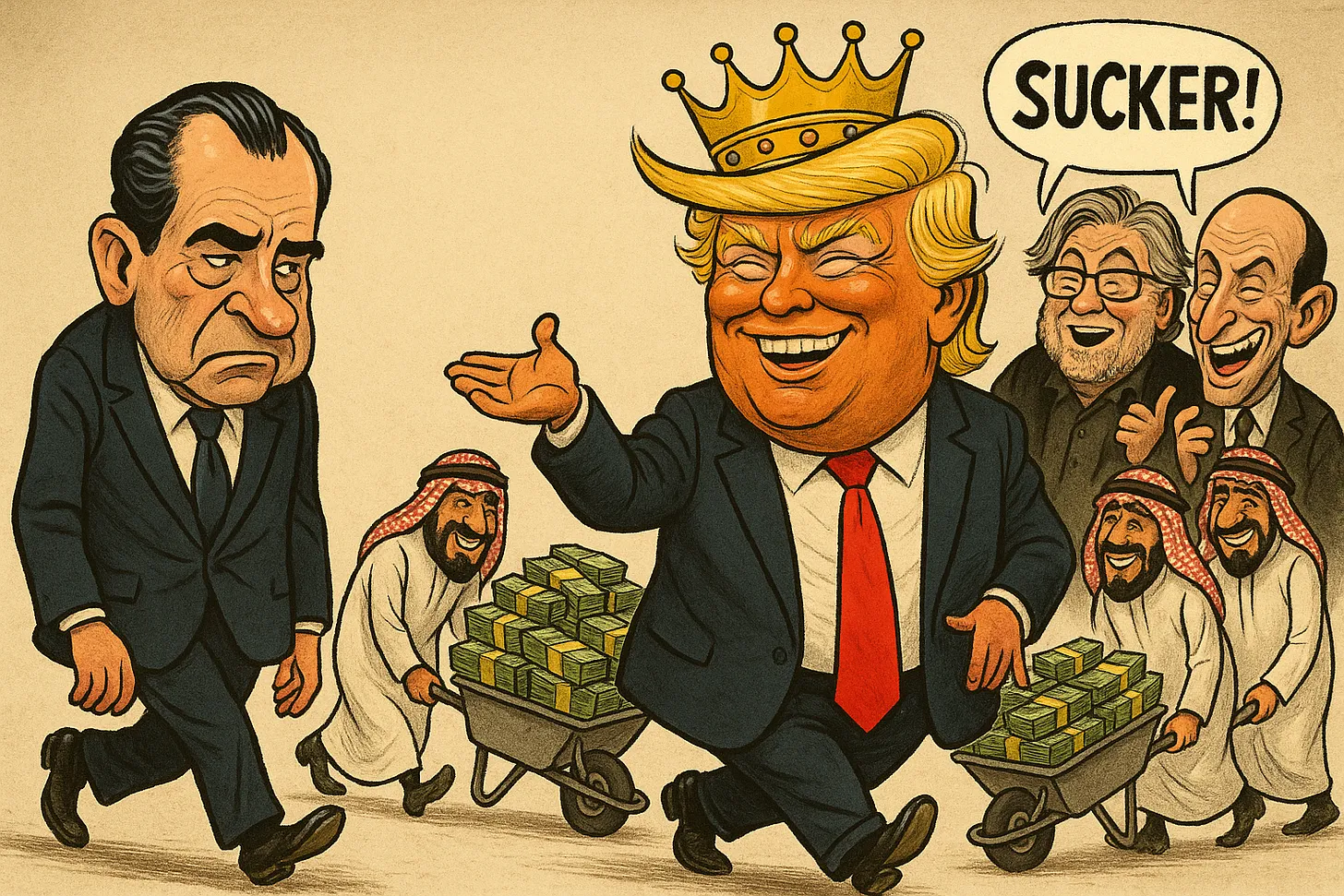
Now let’s go back to poor Nixon. “In all of my years of public life I have never profited — never profited — from public service. … I welcome this kind of examination, because people have got to know whether or not their president’s a crook. Well, I am not a crook.” Tricky Dick? Trump must consider him a sucker!
How could we have fallen so far in 52 short years?
The media is the first broken pillar. Watergate unfolded in a universe with three networks, two national newspapers, and a shared civic narrative. Today’s scandals erupt into a fragmented ecosystem where attention is algorithmic and outrage is commodified. A corruption story that once dominated national consciousness for months now survives for hours before being buried by a thousand smaller storms. Right-wing media, in turn, will defend any breach.
The courts, once the ballast of American democracy, have been neutralized. Litigation moves at the speed of procedure; corruption moves at the speed of opportunity. Compounding this is a Supreme Court that has embraced an expansive view of presidential immunity and a cramped view of oversight.
The Republicans in Congress, meanwhile, have abandoned the very idea of institutional self-respect. There is not on Baker in the chamber. They are all too scared of GOP primary voters, a majority of whom appear to be inclined to support whatever Trump does – in their hatred of the left. Many Americans now assume corruption is universal, and some regard his graft as a form of competence — “the businessman doing business.”
But if we fail to re-establish the basic idea that a president cannot use public power for private gain, then the presidency will cease to be the guardian of the republic and instead become the predator-in-chief, exploiting its institutions as revenue streams and punishing any who resist. Future presidents will study this moment and understand that oversight can be intimidated, the courts can be stalled, the media can be flooded, and the public can be exhausted into silence. And the bureaucracy will adapt in order to survive. Civil servants will learn that integrity is punished and loyalty rewarded. The competent will leave; the compliant will rise. Agencies once designed to check excess will instead become part of the scam – just like in Vladimir Putin’s Russia. A government filled with frightened and complicit people will not defend the Constitution and will not be for the people.
A Congress that refuses to restrain him, a judiciary that declines to intervene, a media that cannot sustain attention, and a public too numb or polarized to care. The Washington Post claimed “democracy dies in darkness” – but this is happening in broad daylight. Democracy actually lies in hopelessness. Sascha Baron Cohen’s brilliant mockumentary asked “Who is America?” Unless we fix this madness, the answer will be quite simple: America is a crook.
