





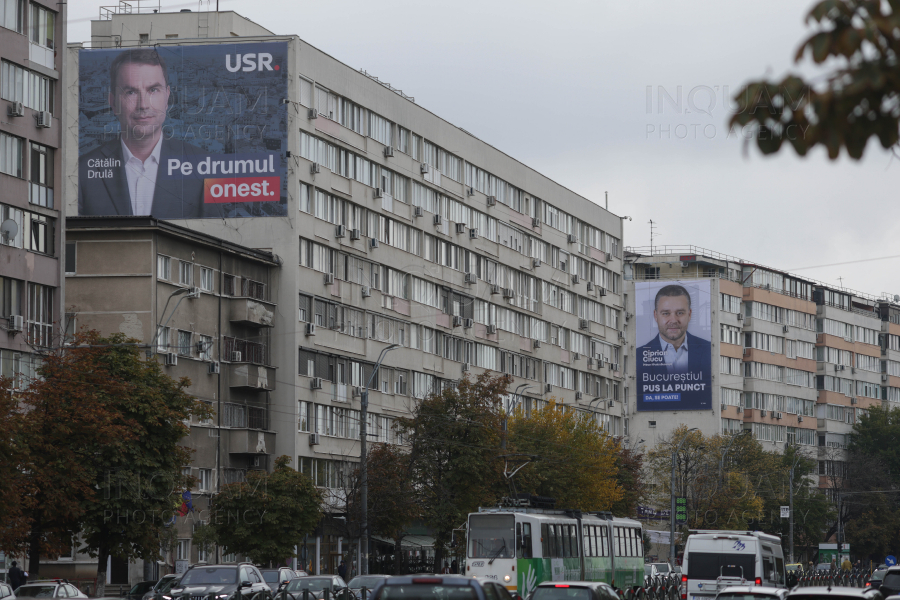
The race to become mayor of Bucharest is crowded with candidates like a May 1 village fair, or the supermarkets before Christmas.
The good thing is that among the candidates which have the best chance in the polls there are two incumbent district mayors, who have won the trust of voters at least twice, a former minister and former party chief – in other words politicians who have experience in high-level public positions and managing large budgets.
Nor is it bad that two of those who announced their entry into the race (Ana Ciceală, from SENS, and Vlad Gheorghe, from the Right Party) represent parties which are not in the extremist-Putinist spectrum. Today the two parties are tiny, but given the dynamics on the political scene and the degree of erosion of the “old” parties, the future of the small ones is far from doomed.
Why did so many candidates enter the race?
The disastrous experience of the Liberals-Social Democrat combination in the 2024 local elections, in the era for former prime minsters Nicolae Ciucă and Marcel Ciolacu, the complicated experience of cohabitation within the current government coalition and the political potential that a victory as Bucharest mayor unleashes have excluded from the start a possible joint candidacy (even if only in the case of two of the major parties in the coalition, the National Liberal Party and the Save Romania Union).
From the perspective of the offer put on the table of the electorate, things look good, because the offer is wide and varied. From the perspective of the legitimacy of the elected mayor, things get a little messy, because with just a single round of voting, the percentage of the winner tends to be capped around 20%.
The Liberal candidate, Ciprian Ciucu, and the Save Romania Union candidate, Cătălin Drulă, ruled out the idea that either of them would withdraw at the last minute, for the benefit of the other.
The decision is logical and a common sense one, since they entered the race separately, and there are only three weeks left until the finish line. The saying goes, if the two parties had really wanted to run under a single name, they had time to come to an arrangement before the formalization of separate candidacies.
But this scenario remains logical and common sense only if nothing changes along the way in the other camp.
However, if things undergo changes, for example in the extremist camp, Virgil Alexandru Zidaru (Makaveli) were to withdraw and announce his support for Anca Alexandrescu (“Georgian” supported by AUR), the logic for the USR and PNL would become obsolete, given the close score the polls are showing among the top four ranked candidates for Bucharest mayor.
And this logic would also remain obsolete if Makaveli, in the event of his withdrawal, did not explicitly tell his guide his voters towards Anca Alexandrescu – because a good part of them would turn to this solution on their own, because it is the most compatible with their visions.
In such a situation, both Ciprian Ciucu and Cătălin Drulă would brutally feel the competition between Ana Ciceală and Vlad Gheorghe as well as each other.
So if Makaveli were to withdraw, and Ciceală and Gheorghe did not, then Ciucu and Drulă would end up in the situation of at least considering the force majeure negotiation of the withdrawal of one of them (Cătălin Drulă starting such a negotiation from a worse position).
If, however, Makaveli were to withdraw and so would Vlad Gheorghe and Ana Ciceală, then, for PNL and USR, an eventual sudden maneuver would not become even vital, such as Drula’s withdrawal for the benefit of Ciucu or vice versa.
At least, this is what results from the data collected by the latest Atlasintel survey.
For the future of Bucharest and Romania, the real stake of the elections for the position of general mayor is that the victory will not go to the extremist-Putinist camp.
Why?
The general mayor of Bucharest is the politician with the greatest legitimacy after the Romania’s president. At the same time, the seat of general mayor (see the cases of Traian Basescu and Nicușor Dan), and, in general, the mayor’s seat of a large city (see the case of Iohannis), was a springboard for the Cotroceni presidential palace. For a complete picture, take into account the cases of Emil Boc and Ilie Bolojan (two mayors who became prime ministers).
PNL and USR would do well to keep their word about taking the fight to the end, each on their own strength – provided that the others also keep their word.
PNL and USR will do harm if they do not change their minds if the worst ranked candidate from the extremist-Putinist withdraws at the last minute to allow the better-rated comrade a leg-up.
Romanian-German journalist Robert Schwartz nominated to head Romania’s public radio station
