











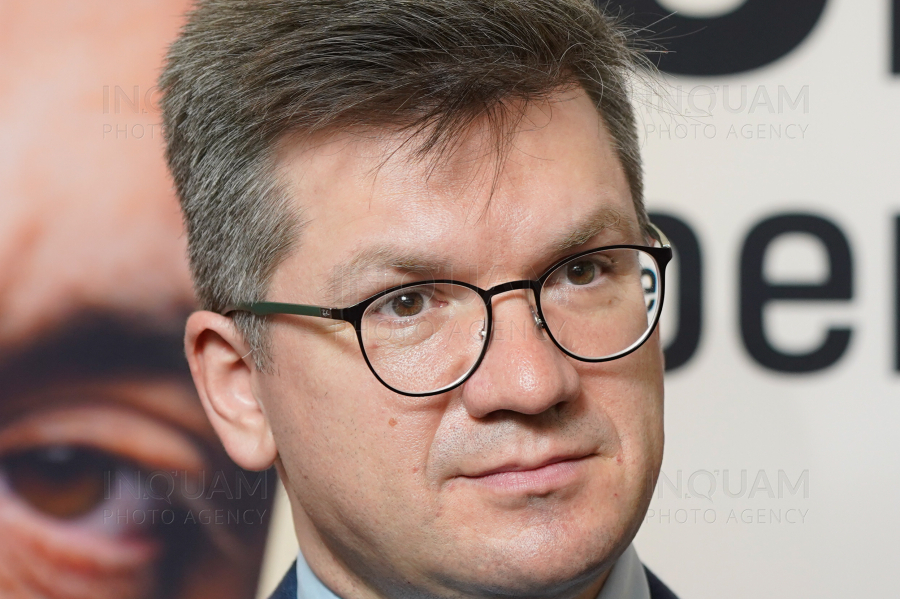
The mere fact that the removal of Mihail Neamțu from the position of chairman of the Committee on Culture was finally discussed in Parliament is a healthy thing, for the image of the institution, for the proper functioning of the committee and from the perspective of the respect owed by elected officials to voters and to the taxpayer in general.
The simple fact that Mihail Neamțu finally managed to make his way to a comfortable parliamentary seat was an unhealthy thing for Parliament and for society, as well as a sad defeat for decency.
And as it turned out in the months spent by Neamțu as a lawmaker and as head of the Commission for Culture, his “coronation” was not good neither for the commission nor Romanian culture.
Mihail Neamțu’s former intellectual friends have made in recent months and especially in the last few days a welcome effort to distance themselves from him, highlighting his flaws, as well as the “dimples” in his writing. We should be grateful to them!
Neamțu’s political rise was thanks to his opportunism, a fact that no longer needs any introduction.
But the lesson of his rise is not only limited to the luck in life that the defects of that individual (in this case, the individual Mihail Neamțu) can bring to an individual, but also to the disaster that the deep and structural defects of a party (in this case, AUR) can create at a national level.
AUR, a party that, like the most widely read of its members, the “educator” Neamțu, has in turn a similar fiber of opportunism, the type of opportunism that needs no introduction.
The reality is that Mihail Neamțu is now a lawmaker simply because since AUR was established, it has been a never-seen-before vacuum cleaner of moral waste (and not just moral…).
If AUR is really good at something, it is knowing how to package products with major problems and quickly putting them on the market as premium goods; it did it with the talent of an unscrupulous merchant, a merchant who cheats you with dodgy scales.
Today, in the well-known international context, AUR’s deep and structural flaws become all the more obvious. In addition to putting together a group of individuals with little common decency or sense of responsibility, and animated by an abject discourse, embittered by their own frustrations, this so-called sovereignist party has injected into Parliament, the most important institution of democracy, a plethora of characters who resonate with something even more abject, even more dangerous: Putinism. Putinism – a horrible dictatorship, a genetic current hostile to debate in general, to civilized debate in particular, to diversity of opinion, to respect for institutions, for the rule of law and freedom itself.
este doar unul dintre acești democrați în straie moscovite, așezați de AUR în instituțiile de la București, este doar unul dintre putiniștii autohtoni, dar se desprinde oarecum de pluton prin faptul de a fi și putinistul cel mai cu moț.
Mihail Neamțu is just one of the democrats wearing clothes from Moscow in Bucharest, just one of the local ‘Putinists’., but somehow detached from platoon by being the most stubborn of them all.
