














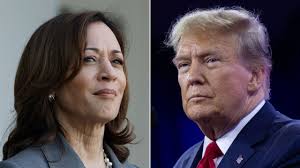
America has a bad case. History shows it can be fatal.
The 2024 U.S. election is not mainly about policy differences, though they certainly exist. It is also not just about the personality of the candidates, which in Donald Trump’s case is a historic singularity. It’s actually about something way more impactful: The two sides seem to look at reality and see completely different things – each considering the other to be dangerously deluded and quite possibly treasonous. This can end badly.
The Trump bit is straightforward: He is, as any child knows, widely seen by his critics as uniquely unfit for office — a leader unlike any other in his personal conduct, moral character, and disrespect for civilized norms. His detractors argue that he poses a singular aberration, pointing to his documented hostility toward the truth, his refusal to concede the 2020 election, and his encouragement of those who stormed the Capitol on Jan. 6.
They point to a pattern of undermining America’s institutions, vindictive and pathologically petty behavior, and willingness to sacrifice democratic principles for personal gain. They fear that he would not hesitate to mobilize federal power against his critics, try to deploy the military to suppress dissent, and dismiss the results of a free election.
These fears are bolstered by Trump’s own starkly outrageous statements, which signal a disregard for the boundaries of his authority. So people speak of emigration and are baffled that their fears are not universally shared. The evidence, they believe, is overwhelming.
And yet, a significant portion of the American electorate views this reality through a completely different lens. About half intend to vote for Trump, and while some of those are willing to tolerate the stark flaws, many seem not to see them. Many profess to be equally baffled at what they consider to be “Trump Derangement Syndrome.”
And here’s where it becomes interesting. A “counter-derangement” has arisen about Vice President Kamala Harris, the Democratic nominee – and an ex-prosecutor with a rather standard personality. The Republican vilification of her is largely based on two ideas: that Democrats want to import immigrants by the millions to vote for them; and that they have “weaponized” the justice system in the mind-bending criminal cases against Trump (who is now a convicted felon, another first in U.S. campaigns). It has worked very well.
That’s how a huge number of Americans now see an existential threat in Harris, who has been tarred and feathered in the MAGA media machine as part of a radical progressive agenda, actively seeking to dilute “American values” and destroy the country’s identity.
These tropes have translated into an increasingly unhinged campaign that features bizarrely racist and misogynistic undercurrents by the bushel (anyone with an especially hard stomach should consider the video at the bottom of the story).
All this seems un-strategic, since the Republicans need American women to reject the possible first woman president and to put aside their widespread opposition to the Republican abortion bans – but then again, authenticity and conviction can create a momentum that defies the standard logic.
The parallel reality paradigm also applies in some cases on the actual issues — like the economy. Despite economic indicators showing inflation dramatically easing, stock markets at record highs, and employment quite reasonable, a large portion of Republicans firmly believes that the economy is in terrible shape, driven by jackhammer agitprop (including from Elon Musk). This perception is shaped by right-leaning media narratives that emphasize economic pessimism, contrasting sharply with the more optimistic views informed by data. For many Democrats, these indicators reflect a robust recovery, yet for many Republicans, the economy feels precarious and even catastrophic. It is about the feeling, and no discussion will change it.
As a result of all this, a huge proportion of the supporters on either side see the other as so misguided — or even malicious — that compromise seems not only improbable but impossible. And whereas I hate to sound alarmist, my experience suggests that when the parallel reality paradigm has taken over the collective mind to this extent, rage and chaos follow, creating a psychosis that can beget violence and collapse.
One classic example springs forth from U.S. history itself: Just about a century and a half ago, the North and South viewed each other as threats to their own way of life, with Southern propaganda portraying the federal government as tyrannical, setting the stage for the Civil War and its devastating toll.
Since then, the factors that contribute to such politics have only grown, especially over the past century as mass media has enabled manipulation with an efficiency once unimaginable, and more recently social media has ramped up the skullduggery further still. This is reinforced by mechanisms from human nature, like confirmation bias and motivated reasoning, where individuals selectively interpret information that aligns with their beliefs while disregarding what contradicts them.
So throughout recent decades, all over the world, we see societies fracturing into parallel realities with disastrous results.
- In Weimar Germany, economic hardship and resentment over the Treaty of Versailles fostered two distinct narratives: one striving for democratic stability and another, fed by nationalist propaganda, vilifying Jews and other minorities as scapegoats. This division paved the way for the rise of the Nazi Party, crushing German democracy and leading to World War II and the Holocaust.
- In Rwanda, ethnic tensions between the Hutu and Tutsi populations were intensified by Hutu extremists broadcasting propaganda that painted Tutsis as existential enemies. This alternate reality of imminent threat drove ordinary people to participate in the Rwandan genocide, where 800,000 were killed in just 100 days.
- China’s Cultural Revolution similarly saw Mao Zedong push a narrative that “counter-revolutionaries” threatened the Communist project. The country was not democratic, yet this narrative had many supporters, creating a society where neighbors turned on each other, intellectuals were purged without outcry, and millions faced persecution, suffering, or death.
- In the 1990s, ss Yugoslavia disintegrated, ethnic groups that were in fact very similar fractured into separate realities, each portraying others as historical oppressors, which fueled ethnic cleansing and massacres during the Yugoslav Wars. A language that was once “Serbo-Croatian” became “Serbian on one side and “Croatian” on the other.
- In Northern Ireland, Catholics and Protestants who were not even actually that religious nurtured contrasting narratives on identity and legitimacy, fueling a 30-year conflict that left thousands dead and communities scarred.
- Indeed, the current American variant of the virus presents a peril to the world. As I talk to people in various countries and of different backgrounds, it becomes clear that the schism isn’t confined to the two Americas. It’s a widespread shift where societies are divided not just along left-right lines but between fundamentally liberal and illiberal worldviews – each unable to really hear the other side.And there is an interesting and ironic twist: The rise of the illiberal side has been strikingly aided by former liberals who are horrified at what they see as the progressive movement’s indifference to the cultural values and societal foundations that created liberalism itself. Many of these disillusioned liberals feel that progressive indifference to the historical values underpinning Western society is wrong. Their unease has fueled a backlash that risks tipping the discussion in favor of the right. Which is what might happen on Tuesday.What does it mean when the country that once championed democratic ideals globally is now fractured by competing, irreconcilable realities? Nothing very good, I fear. Vulgarity will be the least of it.
-
