












The Ratiu Forum Launches “Dialogues on Journalism”
The Ratiu Report has launched a new occasional podcast series entitled Dialogues on Journalism! In the inaugural episode, two of the mentors in our Journalism Mentorship Program, Dan Perry and Alison Mutler, reflect on the dramatic transformation of Romanian media in the 36 years since the fall of communism. Both are well placed for the discussion: Dan arrived weeks after the fall of the Ceausescu regime as the first chief correspondent of the Associated Press as the agency established a presence in the country; Alison succeeded him in 1993 and has lived in Romania ever since.
Their discussion explores how Romanian journalism moved from censorship to openness, from scarcity to saturation, and from post-revolutionary idealism to the harder realities of commercial pressure and the digital attention economy. It also asks a forward-looking question relevant well beyond Romania: what does journalistic independence mean today, and how can it be sustained?
Dan Perry , who served as the chief editor of AP in Europe, Africa and the Middle East, writes and publishes Ask Questions Later on Substack. There is a free tier that still offers access to much content on geopolitics and journalism. We urge you to subscribe!
Alison Mutler is now the director of the Romanian-English publication Universul. It is definitely worth being on your regular reading list!
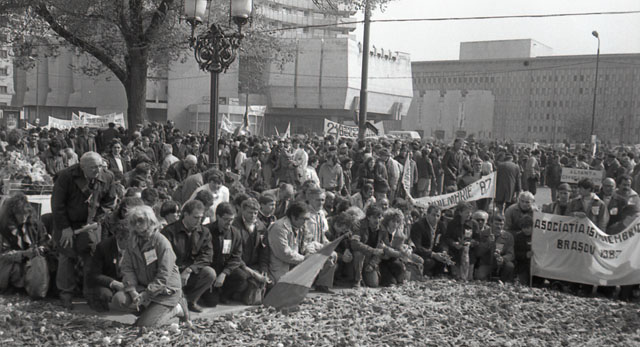
The conversation began with the immediate post-revolutionary period, when Romanian journalism was free but not yet professional. After decades of silence, the press exploded into opinion. Dan recalled how most articles were polemical, emotional, and often badly argued. Facts mattered less than the freedom of expression, after the stifling Romanians had endured. It was chaotic, but it was also the raw sound of freedom before discipline emerged.
Alison described how papers like Evenimentul Zilei broke that pattern by introducing shorter articles, scandal, gossip, and tabloid energy. It was not elevated journalism, but it was readable. It created an audience and proved that people did not want endless political sermons. They wanted information that fit into ordinary life. That shift, they agreed, was a necessary stage in Romania’s media evolution.
Later came other experiments: Cotidianul – headed by Forum founder and former presidential candidate Ion Ratiu, aimed for a more serious, mid-range Western model; the rapid rise of radio in the 1990s; the expansion of television; and eventually the internet. Each phase increased professionalism. Each phase also coincided with a global weakening of the economic foundations of journalism.
Dan himself remembered co-founding Ultimul Cuvint, an effort to a introduce a serious publication — but one with tabloid sensibilities — into the landscape. It was initially very successful, but proved short-lived due to commercial pressures.
Support the Forum’s Ratiu Report: All content is free, but if you wish to support the growth of professionally mentored journalism in Romania and the region, consider joining as a Paid Subscriber or Founding Member. Click the button below for details.
Romanian journalism today is clearly better than it was in the 1990s – yet perhaps more fragile than it has ever been as well.
Investigative journalism exists and has improved, but it survives largely on grants because it is too expensive for the market to sustain. Newsrooms are smaller. Reporters are under pressure to produce enormous volume. Context becomes optional. Verification becomes rushed. Structure collapses under speed.
Alison emphasized that Romanian journalism still struggles with contextualization. Stories often report what just happened without explaining how events connect to the past or why they matter. Without context, even accurate reporting becomes thin. Journalism turns into a stream of updates rather than an explanation of reality.
Dan framed this as a structural danger: without narrative and background, journalism loses authority even when it tells the truth.
They also addressed trust. Audiences frequently say they do not trust the media. Yet when something serious happens — an accident, an election, a war — they immediately turn to established outlets. Distrust has become cultural; reliance remains practical. This paradox, they noted, is not unique to Romania. It exists across democracies.
Their discussion of conspiracy thinking followed naturally. In societies where institutions were long untrustworthy and media traditions are young, false narratives find fertile ground. When neither governments nor platforms are credible, people search elsewhere for meaning, even when it leads to implausible explanations. Romania faces this problem, but so does the United States.
They explored also whether serious journalism should be treated as democratic infrastructure and should be treated as such. Transparent, rule-based public funding is critical – but certain sources of funding can create the suspicion of agendas and bias.
They also discussed the fact that even as newsrooms become smaller, journalism now must integrate text, video, photography, and interactive elements. Visuals are no longer optional. Engagement is structural. But they agreed that technology cannot replace the core requirement: journalism must explain reality clearly and honestly.
What emerged was just a story of Romania – despite the country’s particular convulsions – but one about journalist and democracy writ large. Romania, they suggested, is instructive precisely because it compressed multiple transformations into a single generation: freedom, professionalization, and the disruption of the digital era. It shows how resilient journalism can be — and how vulnerable. It also reflects the importance of a professional and independent media to free societies and markets.
The Rațiu Forum sponsors these dialogues because mentoring journalists today is not only about technique. It is about protecting the idea that journalism is a civic function, not merely a product.
