












Hungarians voted decisively to turn the page, offering a hopeful signal that the populist assault on liberal democracy, and on press freedom, may be losing its grip
For years, Hungary’s Viktor Orban seemed politically indestructible — the master craftsman of mutant innovation that preserves the outer shell of democracy while destroying its core. Votes were held, opposition parties existed, newspapers still were published. But the system was methodically bent to ensure that power, once captured, would be nearly limitless and almost impossible to dislodge.

And yet, with about half the vote counted Sunday, projections in Hungary showed Peter Magyar’s Tisza opposition winning about two-thirds of parliament seats. Orban conceded, bringing an end to the absurd situation in which a post-communist country that had suffered for decades under the Soviet boot and was among the most to benefit from the European Union was the chief backer on the continent of the effort by Donald Trump and Vladimir Putin to weaken Europe.
Punching way above Hungary’s weight, Orban was the prophet and the oracle of the idea that democracy means little more than an elected government. Human rights, guaranteed freedoms, protections for minorities, checks and balances, an independent judiciary – in this model these are schemes by “the elites” to preserve their power and keep “the people” at bay. And the news media? Well, unless it was domesticated, then it is “the enemy of the people.
Trump, Benjamin Netanyahu in Israel, Turkey’s Recep Tayyip Erdogan and Poland’s Law and Justice Party all followed versions of Orban’s “illiberal democracy” playbook: attacks on civil service gatekeepers, manipulation of the justice system, where possible attempted constitutional reforms – and, of course, a constant, jackhammer assault on the media, coupled with attempts to take it over via wealthy cronies. Putin in Russia used these tricks install full dictatorship.
On Sunday night, these fellow travelers were surely watching with concern athe signs that Orban had finally been removed from power. Trump in recent days had even sent VP JD Vance to Hungary to campaign for Orban, and his son Don Jr. tweeted his support over the weekend.
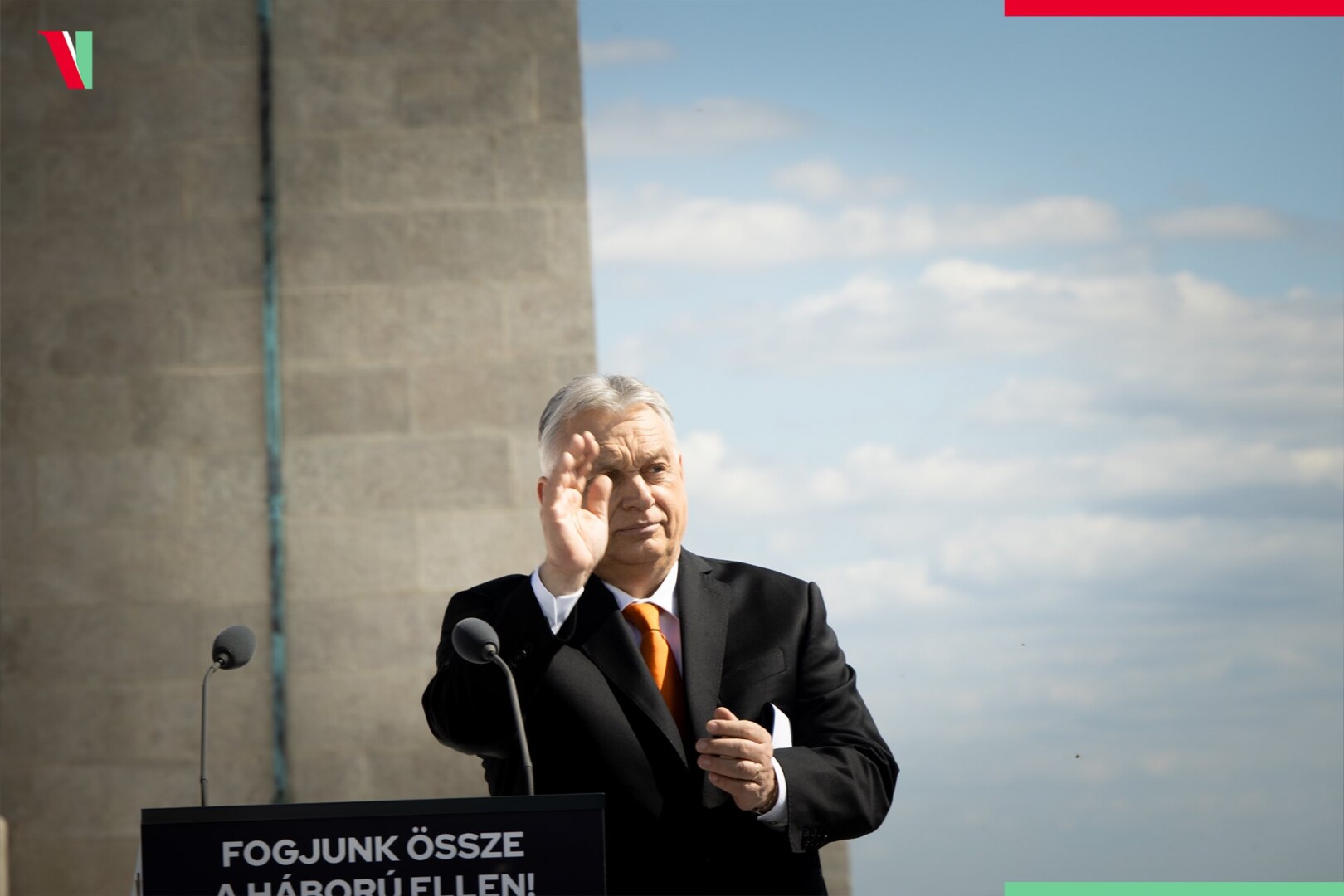
Some had expected Orban to try to falsely claim fraud – which have been a case of the master, Orban, learning from the 2020 election-steal effort of the student, Trump. But the dimesions of the defeat make that impossible — indeed, Orban’s own “reforms” serve to inflate the margin of the winner into a massive majority in parliament. So Magyar (pictured below) will be the new prime minister.

Why does it matter? After all, Hungary is a smallish central European state of around 10 million people only, a far cry from its heyday atop the Austro-Hungarian empire which had a great run until being decimated in World War I.
Well, because of the proposition that elections can carry meaning across borders, reflecting trends and projecting a shift in the zeitgeist that is wider. It would bode ill for Netanyahu in the coming Israeli elections, which must be held by October, and for Trump’s Republicans in the US midterms that same month.
This attaches, for example, to the view by some that the May 2016 victory by the Brexit camp in the UK was a harbinger of Trump’s American victory six months later (putting aside complications like the narrowness of the Brexit vote and Trump’s popular vote loss to Hillary Clinton). Both seem to reflect a revolt by the working class against immigration, globalization, digital disruption, progressive overreach and the self-satisfied nature of the aforementioned elites.
Viewed through that prism, the seeming victory by Tisza party is a breach in what had come to look like a self-reinforcing global model of rule — the populist strongman who wins elections and then reshapes the system so that he never truly risks losing again.
Here’s how that proposition was meant to work.
Since returning to power in 2010 (for he had served a less-angry term as a quasi-liberal in the late 1990s), Orban rewrote constitutional rules, weakened judicial independence, fused political authority with economic patronage, and, crucially, cultivated a media ecosystem that was not outright censored but carefully aligned.
He didn’t shut everything down overnight or impose crude censorship – that would have been illegal, whereas his brand of change operates within the law while constantly moving the goalposts until a country is unrecognizable. Instead, he began by sending unmistakable signals about the limits of independence. One of the clearest assaults on free speech came with academia, in the targeting of Central European University. Through a deliberately tailored law, his government imposed requirements the university could not realistically meet, forcing it to move most of its operations out of Hungary. So a leading academic institution, pushed out by legislation designed to make its presence untenable.
Then came the attack on media. Népszabadság, once Hungary’s leading opposition-leaning daily, was abruptly closed in 2016 after being taken over by a pro-government owner. Officially, it was a business decision. In practice, it was a warning that critical journalism could simply be eliminated. What followed was a 2018 consolidation of hundreds of pro-government outlets — newspapers, television stations, radio networks, and websites, many owned by Orbán-aligned oligarchs — were folded into a single foundation, KESMA, creating a centralized media bloc aligned with the ruling party and shielded from competition laws.
At the same time, public broadcasting under MTVA was transformed into a political instrument, amplifying government narratives while marginalizing dissent. The result of all this was a managed public sphere where dissent existed but struggled to reach critical mass.
Orban understood, perhaps better than any of his peers, that controlling the narrative is more important than controlling the vote. If voters are consistently fed a worldview in which the nation is under siege — by migrants, by liberals, by shadowy foreign forces — then elections become less about governance and more about survival. In such an environment, independent journalism is a threat.
The effect was cumulative: a narrowing of discourse, a blurring of fact and propaganda, and a public increasingly segmented into parallel realities.
Orban used all this to consistently function as an apologist for Putin (for whom he remained an energy client) and a huge skeptic of the effort to help Ukraine defend itself against Russia. Considering that the 1956 revolt against Soviet rule was an iconic (yet failed) moment of the Cold War, this was for many excruciating.
Now, Orban’s apparent defeat suggests that there is a limit to such provocations. That the system finally cracked suggests that even where liberal democracy has been eroded, it is not necessarily extinguished. The machinery of control, however sophisticated, can still falter — especially when the populist loses touch and succumbs to hubris.
The trigger was not an abstract debate about democratic norms but something more visceral: scandal, fatigue, and a growing sense that the government had lost touch with everyday concerns. Orban’s aura of moral authority — carefully cultivated through years of nationalist messaging — was punctured when, despite trading on family values, made the mistake two years ago of engineering the presidential pardon of a crony connected to a child sexual abuse case.
Hungary’s economy was also faltering, with near zero growth. Hungarians who might have been receptive to his anti-EU screeds in the context of immigration noticed that 19 billion euros of EU funds are frozen due to corruption within Orbán’s circle. That did not help, and basically exposed the absurdity of a country whose prosperity depends on Europe casting itself as anti-European.
There may be a lesson in the person of Magyar, who is not an outsider in the traditional sense, nor a standard-bearer of Hungary’s fragmented liberal opposition. He came from within Orban’s orbit — someone who could not easily be dismissed as alien or unpatriotic.
His campaign avoided the traps that had ensnared previous challengers. Rather than engaging Orban on the terrain of identity and existential struggle, he shifted the conversation to competence, governance, and the quotidian failures of the state. Roads, hospitals, bureaucracy, cost of living — the unglamorous realities that ultimately define citizens’ lives.
Voters, it turns out, can grow tired of being told they are always on the brink of catastrophe. They eventually bristle at incompetence and corruption. Magyar is not a progressive, sure; but he is also unlikely to preside over a court of corrupt cronies, support Putin, hate Ukraine, fight with Europe or fawn over Trump.
For the press, all this is particularly consequential, because the populist project has always depended on weakening the credibility of independent journalism, portraying it as biased, elitist, or even treacherous. This was devastating on top of the collapse in the business model of newspapers and mainstream journalism, which has been driven by free online information and the obliteration of all barriers to entry (everyone can be a publisher, reaching everyone else, for free). With the populist fever lifting, we might return to a healthier environment.
Why is it a healthier environment for the free press to thrive? That’s easy. Because the media is not only not an enemy of the people. It is, in fact, a reflection of the people. When we allow a would-be tyrant to demean and diminish it, we demean and diminish ourselves.
