









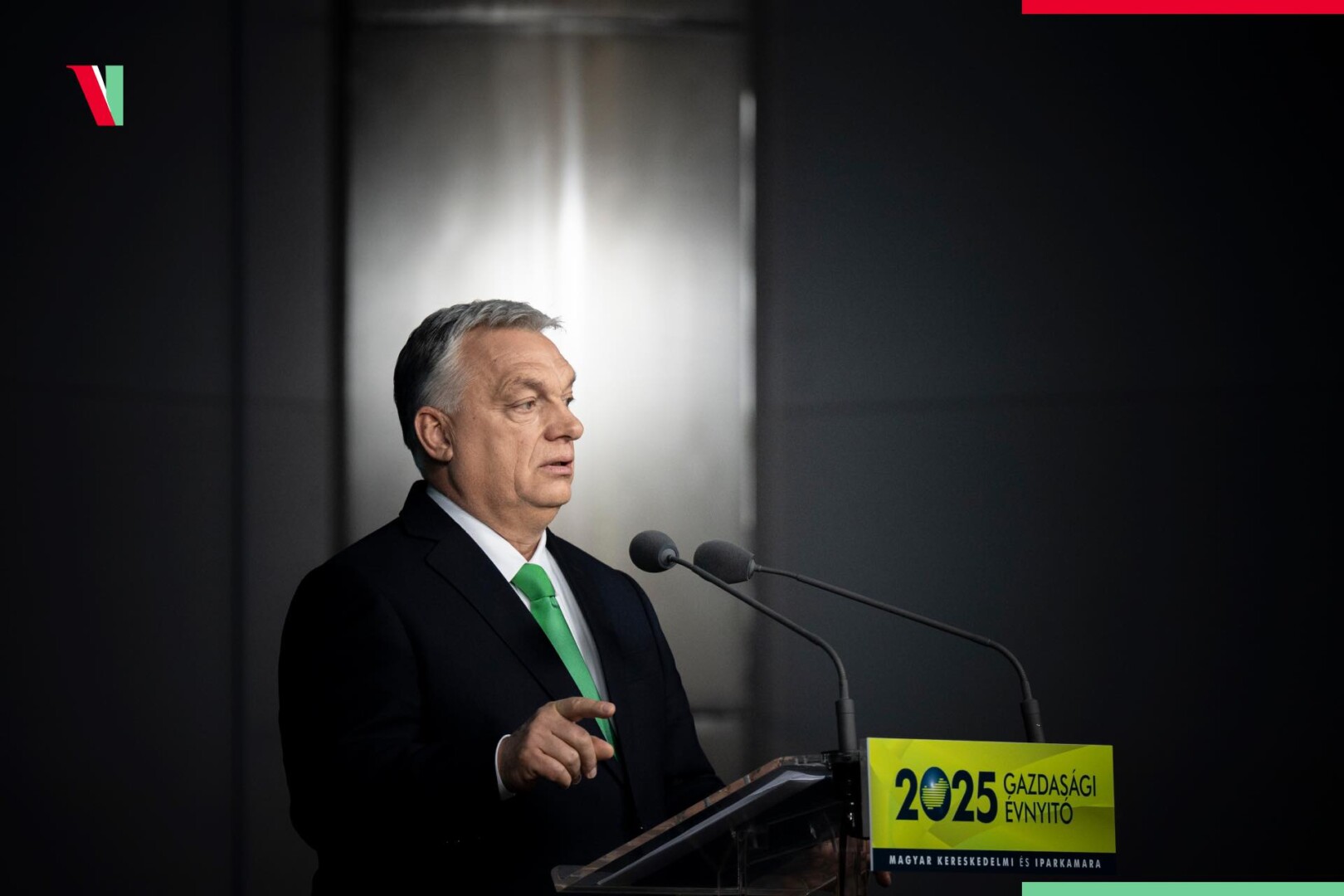
The Prime Minister of Hungary, Viktor Orban, has begun to sell the illusion that he has changed his mind regarding the Romanian extremist George Simion – after supporting him openly in the recent presidential campaign. This weekend, he even painted him as an “enemy”.
Of course, in politics, sincerity and transparency are so rare that nobody expects them anyway. In the case of Viktor Orban’s sudden change of mind over Simion, there is neither sincerity nor transparency.
In less than a year, the Hungarian prime minister faces tough elections.
In April 2026, Budapest will hold national elections, and the latest polls indicate a significant lead (as much as 15 percent) of the main opposition party, Tisza, led by the Orban’s main opponent, Peter Magyar.
Hungary’s marginalization at a European level has become sharper – thanks to Viktor Orban’s pro-Putin position and the subversive policies of his regime within the EU and NATO. This comes in a context in which the country’s economic and political progress has been strongly eroded so much so that ordinary Hungarians come to shop in Romania. It is not only possible, but also likely that the April election will produce a big earthquake.
Under these conditions, the government in Budapest is forced to fight until the last breath for each vote.
In Hungary’s 2022 elections, there were 132,000 Hungarians in Romania who voted, 38,000 more than in the 2018 elections.
A number that is at least not negligible, and given the stakes in 2026, it is not excluded that Hungarians everywhere, including those in Romania, will feel motivated to go to the polls in even greater numbers than four years ago.
Given the weaknesses that both Orban’s party and Orban himself are experiencing today, it is vital for Orban to attract the Hungarian community in our country.
As this is the general context, it seems that the fog on the mystery of Viktor Orban’s sudden change of mind regarding George Simion has totally lifted.
All the more so since, in Romania’s presidential elections, the Hungarian voters and their political leaders, set up Viktor Orban without the right of appeal:
- Leaders of the ethnic Hungarian party, the UDMR, openly criticized the Hungarian Prime Minister’s support for George Simion and openly campaigned for Nicușor Dan (Eds: Romania’s president).
- And ethnic Hungarian voters voted overwhelmingly for Nicușor Dan. Moreover, of the approximately 829,000 votes that Dan won more than Simion, about 600,000 came from the Hungarian community.
For Viktor Orban, given the political pressure at home, with the April 2026 looming, both the figures and the mobilization from the Romanian elections in May 2025 are a bad omen.
The Hungarians in Romania were simply betrayed by the Hungarian Prime Minister, who for the sake of his political stances at the EU level, but also by virtue of his servitude to Putin and Trump, did not hesitate to jeopardize the peace and even the security of the Hungarian community in Romania.
People quickly understood and acted accordingly.
Now, forced by circumstances, Viktor Orban retreats and comes back with a new offer, unscrupulously adapting to the new realities in order to further promote his own interests.
The fact that Orban is not honest about the change of optics towards Simion can also be deduced from another detail: the 180-degree change in his message was not accompanied, as it should have been in principle, by a ‘mea culpa.’ On the contrary, Viktor Orban tries to create the impression that butter wouldn’t melt in his mouth, and that he never supported George Simion, but merely engaged in an act of neutrality.
Viktor Orban’s impertinence is as great as the wealth accumulated by his clan in the 15 years of discretionary power, given the fact that, for the second time in just a few months, he disregards the intelligence and maturity of ethnic Hungarians in Romania: the first time – showing his preference for their enemy; and the second time – saying, despite the evidence, he didn’t do this.
In May 2025, Hungarians in Romania demonstrated without a doubt that Prime Minister Orban’s arm has become too short to lead them by the nose. In April 2026, there are at least good reasons for them to show him again.
Because in the end, any Hungarian – regardless of whether he lives in Hungary, Romania or another neighboring country – notices at least two key things:
- That Victor Orban, although he now disowns George Simion, still continues to play in the same camp as the renegade – Russia’s camp.
- That for 2026, unlike the previous legislative elections in Hungary, a viable alternative to the FIDESZ-Orban offer and government has truly coagulated.
P.S: This is a text I wrote in April 2022:
- “Viktor Orban categorically won Sunday’s elections, but for the Budapest regime this was also the first victory that only wandering minds could have celebrated in the peace of mind of drunkenness, until dawn the following day. The international context in which the FIDESZ-Orban duo’s success at the polls occurred is serious enough for the clear heads in the circle of the Hungarian government can’t ignore and can’t foresee what lies on the horizon”.
I ended it like this:
- “It is hard to believe that the wandering that awaits the rabid bear in Moscow will not be reserved, of course, on another level, for the geopolitical skunk in Budapest.”
The first part seems to be starting to take shape. The last one seems to be on the natural course, but it still takes a little patience to come to fruition.
