






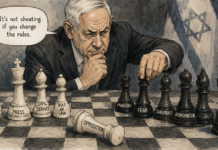




The group is cornered as never before, with Trump’s Gaza plan enjoying near-global consensus. Its choice will reveal the degree of its death wish for Gazans.
The proposal to end the Gaza war, presented by Trump at the White House with a muted Netanyahu by his side, gives Israelis and Gazans a decent outcome from a catastrophic war: Israeli hostages return and Israel withdraws, while for Gazans massive reconstruction, a promising transition and a freeing from jihadism begin.
But it requires Hamas to surrender. That is, obviously, not in the group’s DNA. Indeed, Hamas’s refusal to release Israeli hostages, even as much of Gaza has been reduced to rubble, will go down as one of the most shameful betrayals by a leadership in modern history. The ruination of the Strip is tragic, and Israel has been brutal, but there is a special place in hell for those who were happily willing to sacrifice their own people and gleefully invited catastrophe.
Assuming Qatar and the Arab states are truly on board, we will now see if they can actually control this demonic militia — or if the group is completely suicidal, and willing to carry on without support. That’s because Trump has given Israel carte blanche to ramp up the war even further if the deal is rejected.
Such a scenario, should it happen, will be good for exactly no one. Sadly, that’s actually a model that jihadists might embrace, for they hate you more than they love themselves. A movement that thrives on martyrdom may prefer annihilation, knowing that it would be disastrous for Israel as well, deepening its isolation, inviting international sanctions, and locking it into a costly occupation.
Most Gazans are surely hoping Hamas says yes to the plan. Because the proposal, while vague in places, offers them quite a bit in addition to the very fact of the end of the war:
- It promises the replacement of a kleptocratic and murderous theocracy with local self-government by technocrats.
- It would draw in stupendous levels of outside funding for a global-historic reconstruction, making their cause the cause of the region and the world.
- It incentivizes long-overdue reforms onto the Palestinian Authority, especially in its school curricula, which oddly still preach hate. That’s good for Palestinians too, because it will give them a government that Israelis and the world can again embrace.
- It offers at least a vague outline for Palestinian statehood in the future, conditioned on leadership that rejects war.
- Above all, it removes jihadism from the bloodstream of Palestinian politics, a cancer that has poisoned their cause for decades.
At this point, nearly the entire Arab world has lined up behind the plan—including Qatar, long Hamas’s patron and host of its exiled leadership. For Hamas to reject it under those conditions would be extraordinary. It would suggest either suicidal zealotry or the existence of other sponsors — perhaps Iran, Russia, or even China — capable of slipping it funds and weapons.
But mainly, it would suggest a death wish of an intensity rarely seen in history. If Hamas refuses, it would likely mean the full Israeli takeover of Gaza, a military administration over two million Palestinians, and years of guerrilla warfare with Hamas remnants.
Alongside the attractiveness to Palestinians, it’s also true that the terms align with Israel’s goals in a way that made it easy for Netanyahu and belied the theatrics about Trumpian “pressure” on the prime minister. These were reminiscent of a few weeks ago, when Washington pretended to be shocked when Israel struck targets in Qatar, host to America’s largest regional air base. The claim that Israel acted without US foreknowledge was preposterous. Now, the fiction is that this is a plan purely devised by Trump’s circle—perhaps real estate magnate Steven Witkoff or Jared Kushner – which is foisted on Israel.
Why is it in fact easy for Netanyahu? Consider the details. Whereas the hostages would be released immediately, within 72 hours according to Trump, Israeli withdrawal is tied vaguely to Hamas’s pace of disarmament, leaving Jerusalem in control of the timetable. Restoration of the PA to Gaza and the mere creation of a theoretical pathway to some sort of statehood are all heavily (and vaguely) conditioned and lie far into the future.
In the meantime, Gaza would be run by technocrats answering to an international board led by Trump. Mocked earlier this year for boasting that America would “own Gaza” and “run it,” it is starting to look like at least the latter half of the seemingly absurd claim might come true – even if political realities will eventually push control toward the Palestinian Authority.
So, the overwhelming majority of Israelis back the plan — even Netanyahu’s base. In offering a clearly acceptable narrative to ordinary people on both sides, it is somewhat reminiscent of the Good Friday agreement in Ireland; many will say they see Tony Blair’s fingerprints on the outline.
Don’t take seriously the opposition from Israeli fanatics like Finance Minister Bezalel Smotrich. His ilk are a small minority that want to continue the war and remove the Gazan population with Jews, and are indifferent both to morality and practical consequences. As for Netanyahu, if these disgraceful allies abandon him, so be it — he could go to elections with the plan itself as his platform, especially if paired with normalization with Saudi Arabia and perhaps other Muslim nations. Given the fractured nature of Israel’s opposition, it could revive his currently sagging electoral prospects.
This moment should crystallize something essential that Arab societies have refused to see: theocracies and jihadist militias are a path to ruin. The idea that Hamas is a “resistance” is accepted only by the faraway clueless and local fanatics (mostly in the West Bank and not in Gaza). Hamas – and its fellow travelers like Lebanon’s Hezbollah – are not champions of their people but mafias that traffic in nihilism, oppression, and death. If this war indeed ends with Hamas removed, the region must resolve never again to allow such groups to rise.
Meanwhile, on Al Jazeera, I debated two supporters of Israel’s expulsion from global sports, culture and academia. One of them claimed Israel was massacring 600,000 people and that Oct. 7 “don’t matter anymore,” and the was a former Jewish ANC operative who misquoted Mandela as saying Israel is worse than apartheid south Africa (it was the great leader’s clueless grandson that said something of the sort). It was a challenge to keep up with the torrent of bullshit, and I must credit host Nick Clark for keeping a reasonable lid on things.
There is a legitimate question about whether boycotts are never acceptable — and whereas I cannot say that, I argued against it in this case. Interestingly, when I suggested facetiously that America might be expelled from the World Cup because Trump denies climate change, my angry interlocutor nodded with approval. The US, of course, is hosting the World Cup.
Here’s the discussion, for those with a strong stomach.
Host Nick Clark: Despite its war on Gaza, Israel still plays a full part in international sport and in other competitions on the world stage, including Eurovision. It’s been largely business as usual, despite accusations of genocide by UN bodies and Prime Minister Benjamin Netanyahu’s indictments by the International Criminal Court for war crimes, but pressure is intensifying for action against Israel. All right, let’s get into this straight away. Let’s speak to our guests. In London, we have Ashish Prashar, who’s a political strategist, former adviser to the Middle East envoy Tony Blair, and campaign director for the Game Over Israel campaign. In Tel Aviv, we welcome Dan Perry, former editor of the Associated Press in Europe, the Middle East and Africa. He’s now the publisher of Ask Questions Later on Substack. And also in the United Kingdom in Oxfordshire, Andrew Feinstein, an anti-apartheid activist and author who was elected as ANC member of parliament under Nelson Mandela in South Africa’s first democratic election in 1994.
Dan Perry: Look, I’m a critic of the war and of the Netanyahu government, make no mistake, but I’m not a fan of cultural and sports boycotts and a mixing of sports and politics, which tends to backfire, which tends to target precisely those constituencies that actually are on your side … academic boycotts of Israel target a community that 90 percent of them oppose the government and the war. But primarily, primarily, I look at the outcome here. We’re a very delicate juncture where a peace plan is going to be proposed probably today in Washington that would include and that would require Hamas disarming, stepping aside and handing over control of the strip to a civilian government. Anything perceived as strengthening Hamas, as giving it a reward for its decision to attack Israel and start this war, I fear will undermine the ability of the world and of the Arab world to compel Hamas to indeed accede to these demands. Without that, there will not be an end to the war, end of story.
NC: What about, you know, Dan’s point, his point about timing that doing something like this now, implementing a ban now jeopardizes the push for peace?
Andrew Feinstein: Well, first of all, I’m afraid to say that I’d be quite skeptical of a peace plan that was coming out of the current White House, to be honest, from where we’ve heard, you know, talk of turning the strip into the Riviera of the Middle East, amongst many other things. And some of the plans that are being proposed are actually quite terrifying. That’s the first thing. Second of all, the reality is that the countries who are proposing this peace plan, the United States of America, the United Kingdom, some countries in the EU are massive contributors to the ongoing genocide in terms of weaponry, in terms of spy flights, in terms of the training of Israeli defense personnel. So I think that in terms of timing, there has to be this push for isolation so that even if a peace plan is put on the table, Israel is compelled to accept it under pressure. There have been ceasefire offers that Netanyahu has rejected. At the moment, you could argue that if the conflict comes to an end, Netanyahu could not only find himself out of power, he could find himself in jail on numerous corruption charges.
NC: Dan, what about that? What’s your response to that, that isolation kind of forces Israel into a corner, makes it more likely to accept a peace process?
DP: Well, my suspicion is that Netanyahu will accept this plan that my colleague here disdains, which in fact is, I believe, in alignment with what most of the world wants, including what the Arab League wants. I think we have to understand something that maybe sometimes goes unsaid. There is cognitive dissonance in the global system here. The vast majority of people, including the vast majority of people in Israel, want the war to end. That’s clear. But just as true is that the vast majority of people, I think governments for sure, including the governments of the Arab League, want Hamas to disarm and let go of the strip which they have hijacked and whose population they have been oppressing for 20 years. Now, the only force on Earth right now that actually seems to have a plan for forcing Hamas to disarm, weirdly, is the government of Israel. But no one likes their tactics.
Ashish Prashar: UEFA will throw them out of club football. They’re going to throw them out of European championships. They’re going to throw them out of everything else that falls under their remit. But in the end, the only way we can pressure FIFA to finish the job and it should be finished, because October 7th don’t matter anymore. Let’s just be honest. A genocide where some people estimate 600000 people are being massacred. We should continue that isolation, that punishment. And yes, collective, given that what collectively is being done to Palestinians is beyond anything we’ve ever seen in humanity in the timeline. … This should be collective responsibility.
NC: Dan, do come in there. But keep it brief, if you would.
DP: There is there absolutely is a double standard because the situation is not equivalent. Russia attacked Ukraine, Israel was attacked by Hamas. There was no argument whatsoever for the goal of apartheid, which was to continue a racist racial discrimination in South Africa. There is no argument for Russia’s war of aggression against Ukraine and its desired outcome, which is a domination of Ukraine by Russia. There is near global support for Israel’s goals in this war, which are the freeing of Gaza from Hamas. That that should be clear. They don’t like the tactics Israel’s used and neither do I. But there is a very major difference. Now, we should be very careful about introducing politics into sports and entertainment and academia, because there’s no end to it. What next are we going to ban the US, the host of the World Cup next year, because they deny climate change?
NC: Andrew, let me just let’s move it on, because it was far as the Russia element is concerned, the president of UEFA indeed himself has said that we are among the first to act, truly believing that sport could help put an end to this tragedy. Did it stop the war?
AF: No, it didn’t. No, it didn’t. But did it add to the pressure on Russia? Absolutely, it has. I mean, we’ve seen Russian tennis players who aren’t able to play under their national flag, which has caused great problems for them. Does this add pressure on the politicians who are keeping the war going? Of course it does.
NC: Dan, I’m just wondering if we just switch to Israel itself for a moment. How do the majority of people there feel about this potential ban and this this growing sense of isolation? You know, the phrase the pariah state is used is banded about quite a bit. What’s the sense within Israel amongst the majority of people about that growing isolation?
DP: Well, it’s absolutely true that there is growing isolation and it’s also true that, you know, economic boycotts in particular and pressure like that can yield outcomes undoubtedly. But the cognitive dissonance I mentioned before exists in Israel as well. Most people want the war to end, but pretty much everyone supports the goal of removing Hamas from power and disarming them one way or another. And the belittling of this goal by my fellow panelists here is positively absurd. You say most of the world doesn’t care about disarming Hamas, really? Maybe you should ask the people in Gaza. And by the way, Hamas was not elected to rule Gaza. Hamas won a plurality, not a majority in legislative elections for West Bank and Gaza four years ago. I’m explaining that this could really backfire and the people in Israel, probably the third or so that still support the war, are not going to be convinced by by any version of this sort of punishment. Whereas the two thirds or more that want to end the war already want to end the war. They don’t need compelling. And, you know, removing them from the family of nations, I’m not so sure is the right thing to do. Like I say, there’s no end to it. The minute we introduce politics, there’s no end to it. Consider that most knowledgeable factors in the world understand that it’s bad for the Palestinians, for Hamas to continue to exist as a militia, undermining the Palestinian Authority. For God’s sake, how can we ignore this very basic and obvious thing?
NC: Actually, it’s another argument that Dan alluded to … (the) unifying nature of sport. The case that sport and culture provide this chance to bring people together and should stay outside of politics. And it could help the furtherance of peace and understanding. That’s a good argument, isn’t it?
AP: Look, the point I’m making is for Israel, the UN declared it a genocide. Now people is beyond reproach on this issue. It doesn’t matter what the scholar says in Tel Aviv or anyone else. By the way, Israeli scholars have called it genocide. Punishment of that is collective. Unfortunately, this is a society that has done one of the most horrific crimes imaginable. And sports normalizes the acceptance of genocide. If we allow them in normal arenas, we accept that this genocide is OK. The apartheid that Israel have over Palestinian is OK. And the occupation they have over Palestinian is OK. And they have to be isolated. And that starts with sport. And once football goes, the Olympics will go. They are more like South Africa than Russia. The isolation will cripple them to Andrews Point and then economically cripple them and bringing them off the table of other nations is the most important thing we can do to bring an end to this and deliver justice for the Palestinians who suffered in this genocide.
NC: OK, Dan, briefly come back on that sport normalizes what Israel is doing.
DP: What Israel is doing is not comparable to the crimes that you mentioned. You keep saying genocide as if saying it 100 times and then falsely attributing it to the entire UN. So get to that, if you would. The situation is abnormal and the situation is complex. And what needs to happen is for the things I said before, for Hamas to disarm and to step down. That’s it. There is if the minute that happens, the war is over. And that really undermines the claim that Israel intends to destroy the Palestinian people in whole or in part. They intend to achieve the goals of this war. And the manner in which they are doing it is very ugly. And I am no fan of it. But I am aware which you guys seem not to be. That if Hamas surrendered tomorrow, gave up the hostages and handed over the keys, the war would end. The so-called genocide would end. You seem not aware of this.
AF: If we assume the genocide is being committed to achieve whatever objectives Israel wants to achieve – and unfortunately, in this instance, the means simply cannot justify the end because we are seeing a genocide – the reality is we in the rest of the world have to do every single thing we can to bring to an end this genocide. Sports boycotts are the very least we can do. Sports boycotts should be part of a process that leads to massive and total BDS and isolation of the state of Israel.
NC: And Dan, isn’t this the essential point, which is coming to the end of the program, so briefly, if you would, that aside from everything else and the disagreements that you guys have, isn’t isolating Israel from sporting cultural and academic contact? Won’t that make it clear to ordinary Israelis that their government’s policies have a cost and should not continue? And something’s got to change.
DP: I think it’s very clear then most Israelis know that, which is again why most Israelis want to end the war. I think the tool of isolation and boycotts and being expelled from sports tournaments should be reserved for the very few cases where there is absolutely no defense of what a country is doing. And there is wall to wall opposition to everything about that policy. This is not the case here. And even if you guys repeat genocide falsely a hundred times on the show, it will not make a genocide. Israel is supported by most of the world and most of the world governments in its goals, and I’ve repeated them ad nauseam on the show. And the war would end if those goals were achieved. So therefore, this is not the case where boycotts are necessarily wise. What needs to happen is is massive, maximal pressure on Hamas to free the poor people of Gaza from their grip.
NC: Thanks very much indeed for speaking to us. Ashish Prashad, Dan Perry and Andrew Feinstein. Thanks very much indeed.