








As imperfect as it is, Romania has a quality that is appreciated many residents and foreigners: there is little street violence. The average person feels relatively safe when they leave home. The Romanian state is functional, liberal and compatible with states in advanced democracies.
There are forms of aggression, of course, because Romania is still far from being a Garden of Eden. Traffic comes to mind first, and there are occasional fights in the street between criminal clans, we can’t pretend they don’t happen. And there is a a level of domestic violence we should feel ashamed of. We need to improve conditions for women and children and make the reduction of this scourge a top priority.
And yet, on a general level, in many localities in Romania it is (still) safe enough to walk the streets at night with no particular stress, something that is not necessarily true in countries significantly considered more advanced than ours.
Such a success in terms of public order seems somewhat implausible if we consider other breaches of Romanian state.
But this fragile success, one which is much appreciated by locals and tourists or expatriates who came to love here, may easily disappear starting Monday, May 19. And it can do it so quickly and so brutally, that people will wonder whether it ever existed in the first place.
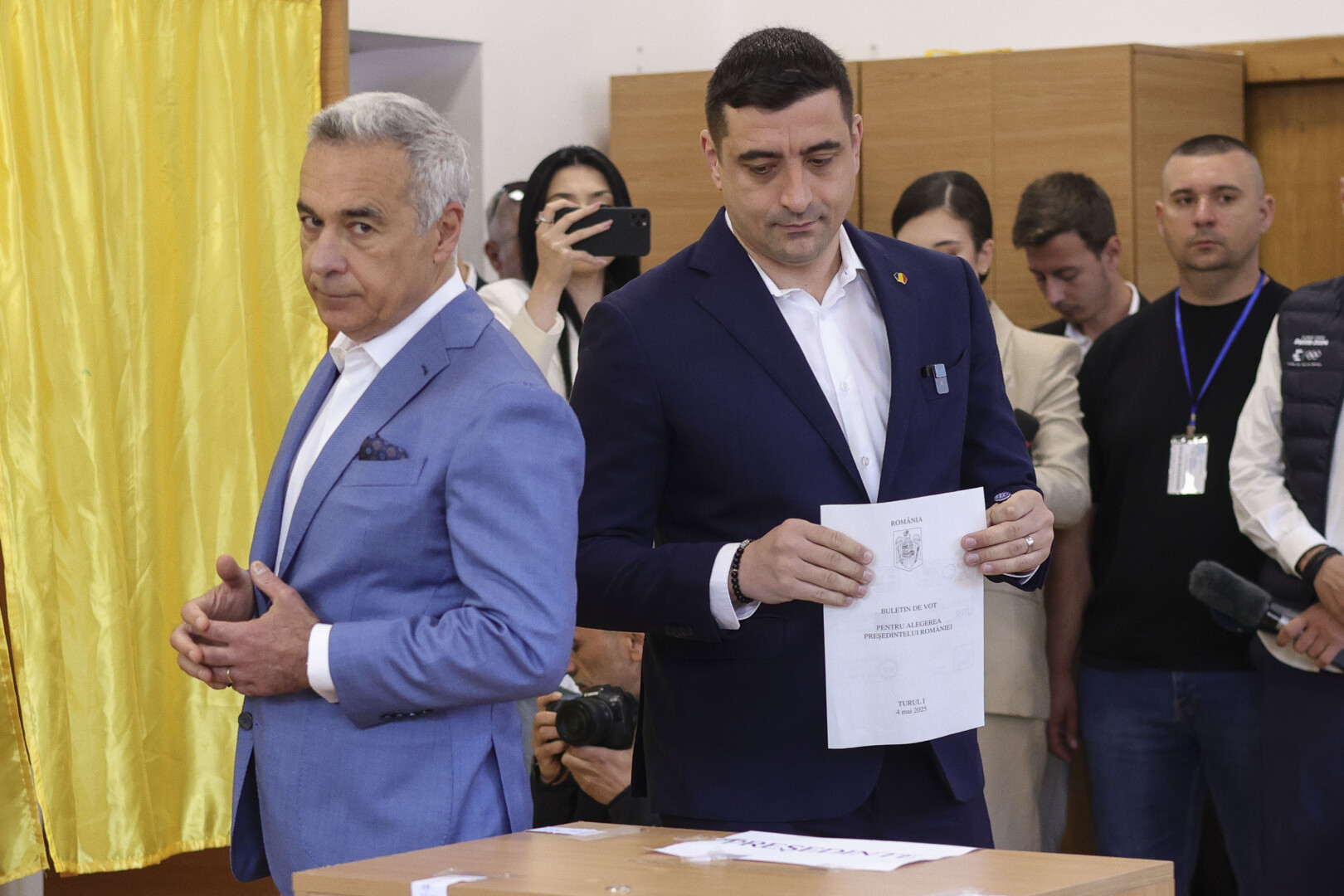
For the collapse into an abyss where violence is commonplace and routine, only one thing is needed: George Simion’s victory in the presidential elections on Sunday, May 18.
There are plenty of signs – some are deeply related to Simion’s path and approach, others are deeply related to the vision of Calin Georgescu, the one Simion wants to appoint to high office.
In fact, the saying that it never rains but it pours seems to fit this case perfectly. Why?
Because the Simion-Georgescu couple has the potential to overwhelm Romania with a wave of violence.
On the one hand, at the grassroots level (on the street, at the market, at the movies -in people’s daily lives). And on the other hand, at the top of the pyramid – in the political environment, in the journalistic environment, in the civic environment – through state violence, exercised comparable before 1989).
The first category will be delivered via the “Simion phenomenon”, and the other via the “Georgescu phenomenon”. As time passes, in the Romania seduced by Georgescu and led by Simion, the two directions will probably intertwine, a combination of getting drunk on power and needing to preserve it at all costs.
At the Simion level, as I said, grassroots violence will tend to become the new reality because as a public figure George Simion has been molded in grassroots violence – in football stadiums, on the street, in various “civic actions” meant to bring him to public attention.
Then, let’s remember, once he moved into politics, Simion raised the level of aggression in this area to levels never seen (or maybe not even then) since the time of Corneliu Vadim Tudor and Gheorghe Funar (Eds: two 1990s Romanian nationalists). Verbal aggressiveness, aggressive actions – all this has been reinvented in Romania with the rise of AUR (Eds: Romania’s second biggest party) and George Simion at its helm.
At one point, in Parliament, George Simion jumped at the neck of the Minister of Energy, Virgil Popescu. And Gigi Becali recently said that the same “George Simion swore at Neamțu, he wanted to beat Mihail Neamțu (a lawmaker) in front of everyone. When I heard something like this, I called Neamțu: Mihai, why did you stay in the party? That can’t be done.”
In turn, AUR rallies have become more and more dangerous for journalists to cover due to verbal aggression and attacks on journalists’ equipment. For all its sins, Romania has not witnessed anything like this for over two decades, possibly since the time of the communist Iliescu’s hatred of Coposu, Rațiu and the peasants, towards the intellectuals, who wore glasses and had beards.
A man with George Simion’s philosophy of life and way of doing politics, it is hard to imagine that he will bring a diametrically opposite atmosphere – silence, dialogue, moderation, deliberation, cooperation to society.
As I mentioned above, there is a saying that it never rains but it pours, and the “Simion phenomenon” will be doubled by the “Georgescu phenomenon”.
And with Georgescu, violence will be at the highest levels, although not just there (not exclusively, although Călin Georgescu has given clear signs that he is similar with his predilection for the company of mercenaries and bodyguards).
But Georgescu’s influence on politics starts with the political parties.
“Political parties are hooligans in the golden chariot of the Romanian people. There will be no more political parties in this country. None! No political party! Because the ancestors are alive,” said Călin Georgescu in April 2024.
The abolition of parties, no matter how imperfect the parties may be, means nothing less than pure dictatorship. And dictatorship means not only violence on the street or in the market, but above all state violence, systematic, censorship, political prisoners – nothing less than what Romania had had even in the darkest years of Ceausescu, when Calin Georgescu had the luxury of traveling and being educated in America and Great Britain.
Decades of communism mutilated Romania decades later precisely because at that time Romania had no parties, none other than one single party, the Romanian Communist Party.
This is the country that Calin Georgescu dreams of, this is the country that George Simion promises, since he considers himself the electoral and spiritual successor of Georgescu and since he is considering appointing Calin Georgescu to a position of power.
In Simion and Georgescu’s Romania, millions of Romanians will leave their homes in fear -afraid for their safety on the street, fearful of the new Securitate officers who are always vigilant and on the lookout for new dissidents.
In Simion and Georgescu’s Romania, millions of Romanians will be afraid to open their mouths, and live in fear of the thugs on the street, and the political system that will come in if Simion and Georgescu come to power.
In Simion and Georgescu’s Romania, the millions of Romanians in the diaspora will never return home, not even on vacation. They won’t come back because they won’t have any reason and they too will be afraid – they will be afraid on the street, afraid of the state, they will be afraid to open their mouths, afraid even to consider themselves Romanians.
The last dictatorship installed in Romania was communism. The Russians installed it by force helped by complicit Romanians who were willing to betray their brothers. It was installed through electoral theft, with a massive injection of fear. It used big words and great ideals, it fed illusions through pharaonic projects and it did not go away for 45 years.
When the dictatorship finally collapsed, it did so because everyone hated it. But it left a long, thick and trail of blood, the blood spilled the more than 1,100 who were killed and the 3,300 wounded.
When the communist dictatorship was installed, Romanians had no choice, they had no means to prevent it. Everything – from the domestic to the international context – was then against them.
Now, however, when the risk of another form of dictatorship is is higher than ever in Romania, our generation at least has the chance to make an informed choice, to defend itself, or to surrender. An informed choice, a choice within the reach of each of us – that is, a luxury that our grandparents and great-grandparents were fatally deprived of.
“Romanians face a historic choice—Putin or America”- seven ex-US Ambassadors tell Romanians
