




The 2026 edition of Eurovision, which marks the competition’s 70th anniversary, is set to feature 35 countries and will be held in Vienna, Austria, from 12 to 16 May.
Public broadcasters in Ireland, Spain, and Slovenia have opted not to televise this year’s Eurovision Song Contest, instead deciding to boycott the event in protest against Israel’s inclusion.
After first having decided not to enter a contestant, Slovenia’s national broadcaster, RTV, proceeded to confirm that it will also refrain from airing the competition altogether. In place of Eurovision, it plans to broadcast a curated series of films focused on Palestine.
“We will not be broadcasting the Eurovision Song Contest,” said RTV Slovenia’s director, Ksenija Horvat, in a statement to the Associated Press, adding that viewers will instead see the film series Voices of Palestine, which features both documentaries and feature-length works by Palestinian filmmakers.
Spain’s public broadcaster, RTVE, reaffirmed its own decision last week not to air the event, marking the first time since Spain began participating in 1961 that Eurovision will not appear on Spanish television.
Meanwhile, Ireland’s RTÉ had already announced in December that it would neither take part in nor broadcast the contest.
Although the Netherlands and Iceland also withdrew from participation late last year, their respective broadcasters, NPO and RÚV, will still carry the show.
These withdrawals follow the decision by the European Broadcasting Union (EBU), Eurovision’s organizer, to permit Israel’s participation despite ongoing criticism of its actions in Gaza. Slovenia’s prime minister, Robert Golob, recently re-elected in a closely contested vote, has been particularly outspoken on the issue. In August 2025, his government introduced a ban on imports from Israeli settlements in the occupied West Bank, citing concerns over policies it says undermine prospects for lasting peace.
Operating under the slogan “United by Music,” Eurovision has long aimed to separate pop culture from political conflict, though it has repeatedly found that global tensions spill into the event. Russia, for example, has been excluded since 2022 following its full-scale invasion of Ukraine.
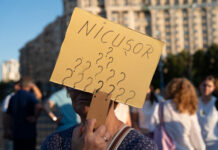
Now, protests are taking place outside Eurovision venues.
Organizers have responded by tightening restrictions on political displays, including flag usage. In fact, this year, new rules will also be introduced to limit the ability of governments or external actors to promote entries in ways that could sway public voting.
