














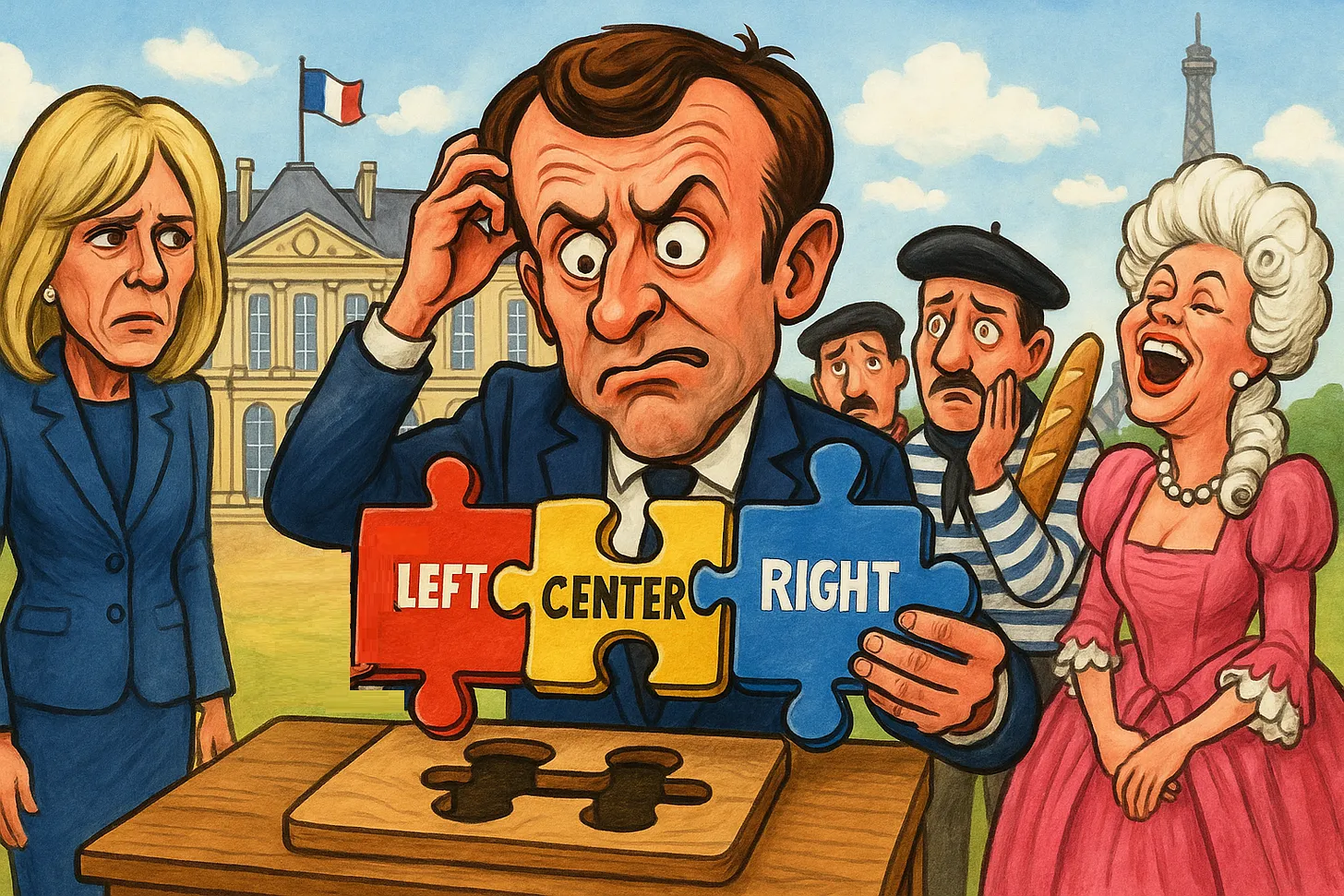
CLAIRE BERLINSKI WRITES: A system built for two sides cannot govern a nation divided in three. France’s presidential monarchy has become the source of its own instability.
When Charles de Gaulle founded the Fifth Republic in 1958, he believed he had found a cure for France’s chronic instability. He endowed France with a massively powerful presidency, but also a parliament whose assent was required for significant action. For decades, this contradictory formula worked: larger-than-life leaders like de Gaulle himself usually got their majority — or, in any case, their way.
This article is the second in a series about political systems that may no longer be fit for purpose, distorting ideological reality or yielding unworkable outcomes
The problems the Fifth Republic was designed to solve were hardly imaginary. Between 1946 and 1958, France cycled through twenty-one governments. Cabinets were cobbled together from a dozen feuding parties, dependent on fragile coalitions that could be toppled by a parliamentary tantrum or a ministerial slight. Ideological divides among Gaullists, Communists, Christian Democrats, and Radicals were fierce, but the deeper fracture lay in a political culture addicted to negotiation without resolution.
To support the defense of democracy, decency and reason, consider unlocking full access to Ask Questions Later by upgrading to a Paid Subscription.
As France bled in Indochina and tore itself apart over Algeria, no one could hold power long enough to govern. The paralysis threatened to discredit parliamentary democracy itself and left the country vulnerable to demoralization, conspiracy, and military mutiny. De Gaulle’s remedy was an elected monarch, or very near it, whose legitimacy flowed directly from the people.
It had a good run. France enjoyed what it craved—grandeur, continuity, and men of stature who strode confidently across the world stage. The constitution’s weaknesses were masked by strong personalities: Pompidou, Mitterrand, and even Chirac dominated the system by force of character. So long as politics conformed to the familiar terrain of Left and Right, the Fifth Republic seemed, if not eternal, at least good enough.
But a constitution built for two parties can’t govern a nation fractured in three.
France in 2025 is divided, as Julius Caesar once remarked of Gaul, into three parts: a squabbling center of Macron’s technocrats, occasionally making tactical alliances with the enfeebled traditional parties; Marine Le Pen’s nationalist right, occasionally buttressed by the Republicans; and Jean-Luc Mélenchon’s radical left, occasionally assisted by the Socialists (though they loathe each other). Each bloc has its own press, its own moral cosmology, its own diagnosis of France’s malaise. None commands a majority; none can compromise without self-annihilation. The presidency, deprived of its majority, has ceased to be a unifying symbol — save in the sense that these squabbling parrots can at least agree they loathe Macron. He has instead become a multiplier of division.
When the president and the government come from different parties, the French call it cohabitation. De Gaulle intended this to be exceptional: a constitutional curiosity. Under Macron it has become the norm. Since losing his majority in 2022, he has governed by decree, procedural sleight of hand, and constitutional gimmickry. Five prime ministers have come and gone in as many years, each lasting only long enough to become an object of scorn.
The brief (first) tenure of Sébastien Lecornu, Macron’s loyal defense minister turned sacrificial prime minister, was the latest proof of the system’s dysfunction. Tasked with passing a budget through a National Assembly that despises itself almost as much as it despises him, Lecornu lasted about a lettuce — a unit of political-time roughly twice as long as a Scaramucci. His government fell within a day of announcing its cabinet, undone by accusations of deceit from the right and obstruction from the left. Yet with comic fatalism, Macron promptly reappointed him. Memes depict Macron giving France the finger. Accurate enough. Thus, a constitution designed to fix the weaknesses of the Fourth Republic now ensures their recapitulation.
