












No one does more or something so systematic to make a mockery of the idea of you Romanians living abroad to ridicule a meaningful debate about the problems, the fulfillments, the potential and the place of the Romanian diaspora. Just as no one systematically undermines the legitimacy and benefits of Romania’s integration into the EU by misusing the diaspora than George Simion and Calin Georgescu…. At this moment, no one is harmful to the interests of Romanians in the country and abroad than those two.
Both have turned speeches about the diaspora into a wall of complaint and that’s about it. Their actions point to a single and obvious direction: ROEXIT.
If you listen to Simion and Georgescu, you are left with the impression that in the diaspora everything is disastrous and the Romanians there are unanimous in that opinion: they all want to return to Romania, they all regret leaving Romania, not one of them enjoys a good life and were all forced to leave Romania because they were driven out. This was the only reason that Romania opened its borders and joined the EU.
A more odious lie that than one concocted by Simion and Georgescu could not be created.
Fortunately, the reality that the two pro-Russians are trying to twist is far brighter than the tragedy and sob story that Simion and Georgescu are trying to conjure up. (Its is no coincidence that the pro-Russians in Romania are striving to create a picture of absolute victimization of the Romanians who left Romania and to demonize their life and work abroad!)
As everyone well knows – including George Simion and Călin Georgescu – the millions of Romanians who left Romania are not a solid mass; they did not have the same motivations, they didn’t all leave at the same time and their lives aren’t identical, nor are their future plans, or the way they relate to Romania.
Some left out because they had to; others because they had better opportunities waiting for them, others because they wanted a new experience, others out of a spirit of adventure, and others simply left after the Revolution, because they were able to after decades of having been forbidden from traveling outside Romania.
Then, after three and a half decades of freedom of movement and after two decades of ease of moving and settling elsewhere, thanks to Romania’s admission into the EU, the Romanian diaspora has been structured on another level: those who arrived abroad as adults, those who arrived there as children, and those who were born there.
In each of these three cases, both the reporting to Romania and the reporting to the foreign country that is their host are different. Their daily challenges are different, as is the potential for personal development, and what for each one means success, as well as what failure could mean for each one.
But according to George Simion and Călin Georgescu, there is no nuance when it comes to the diaspora, even though there are millions of Romanians abroad, each with a different background.
The reason is simple: George Simion and Calin Georgescu don’t care about the fate of Romanians in the diaspora, only about exploiting the theme for their strategic ends: getting Romania to leave the EU and by extension the West and joining up with the West’s declared enemy – Russia.
The longing for the country – a large-caliber projectile from the “diaspora arsenal” with which Simion and Georgescu try to blow up Romania’s Western path – is a reality and it is not in any way to be ignored or ridiculed.
But longing is a reality that the millions of Romanians who have left feel differently – some deeply, others relatively superficially, while others not at all.
Personally, I do not have statistical data on the weights of the three categories in the mass called the diaspora, but neither do Simion nor Georgescu, although they fake an abolsute onging for the country of the Romanian who went abroad.
Then, let’s be honest and not fall under the spell of weak exceptionalism: the Italians, the Portuguese, the Spaniards, the Poles, the Hungarians, etc., felt the longing for the country – again, in different concentrations.
Moreover, considering the percentage of Romanians in the diaspora who voted on December 1, 2024 for extremist parties for the national Parliament, who voted in November and then in May for Călin Georgescu and George Simion, respectively, for the presidency, it is clear that a significant number of these people embraced without reflection on the emotional, and profoundly dishonest approach, of pro-Russian extremists, on the topic of the diaspora.
In this final week before the runoff, it would do a great deal of good if these people would remember at least a little joy or at least relief that they have a choice. That they have to choose what to do with their lives – whether to stay in the country or to leave.
But above all, they should all thank with all their being for the generous course of history (starting with December 1989 and continuing with the moment of accession to the EU).
For this generous march of history on the one hand has given them the opportunity to choose whether to leave or stay, and on the other hand has given them an unimaginable array of friendly destinations to head to and settle in (it is no coincidence that backward and autocratic Russia has been avoided by all!).
The generations immediately before them had not had any of these chances.
Whoever chose, before 1989, to leave, risked being caught by the Securitate and kept a prisoner in Romania. Of those who managed to dodge the communist secret police –the very few who were extremely careful- some were arrested or shot at the border, others drowned in the Danube.
And all those who managed to leave paid dearly (either through bribes, or by being separated from their families for years, or by embarking on dangerous routes and staying in temporary refugee camps or prisons).
Moreover, before 1989, Romania was a pariah country, the EU did not exist for it, so settling in another country was an ordeal in itself.
The wretched people who kept Romanians prisoners in their country for decades or made them flee from extreme torment were not foreigners, but also Romanians: members of the communist leadership of Romania.
The communist leadership of Romania was planted after World War II by the Russians. The Russians made sure during the decades that followed that the clique of communist Romanians remained in power and would shape Romania in the image and likeness of totalitarian Moscow, removed from the West.
A first irony of fate is the fact that in November 2024 an individual – Călin Georgescu – deeply connected to and cultivated by the communist regime, called on us to vote for him.
The second irony of fate is that after initially trying his luck in the presidential elections on November 24, and now, for May 4 and 18, an individual – George Simion – rather fond of the Ceausescu era is asking us to vote for him. “He was better intentioned” is how Simion described Communist leader Nicolae Ceausescu in November 2024, a few days before the first round. He declared this, therefore, as a candidate for Cotroceni.
The George Simion and Călin Georgescu pair are manipulating the diaspora with total contempt for the Romanians in the diaspora and for their fellow Romanians back home. Both, Simion and Georgescu, fish for tears and sighs, in their mad rush for cheaply obtained votes and with which they will mutilate everyone’s present and future lives.
If Simion, supported by Calin Georgescu, is elected president of Romania, the country will plunge into a vast and deep ocean of uncertainty, poverty and instability.
But two things can be taken from now on as well-circumscribed certainties, in case Simion is elected president:
- After May 18, a new and strong exodus from Romania will follow. Perhaps the saddest, most excruciating and humiliating exodus of the last three decades!
- After May 18, Simion’s success at the polls in Romania will blow fresh wind in the sails of the extremist parties in Europe – those parties like AUR, POT and SOS, which you can also find in France, Germany, Italy, Spain or Great Britain. Parties with a profoundly anti-foreigner agenda whose rise will also make the lives of Romanians in the diaspora an ordeal, including or perhaps first of all, those Romanians who refuse to understand the true nature of Simion and Georgescu and, as such, will vote for Simion.
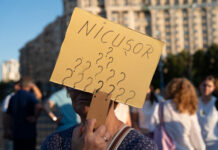
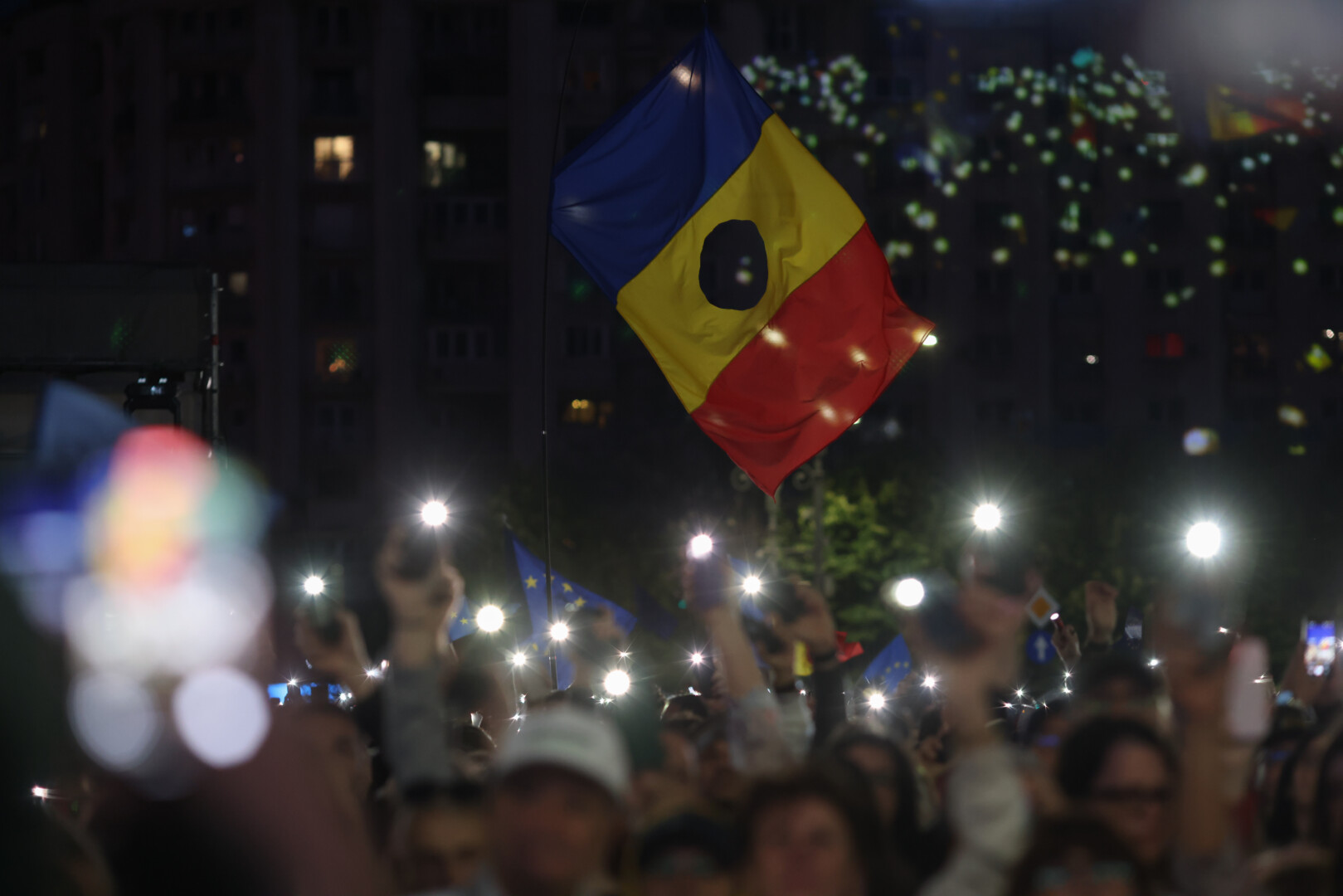
Thousands rally for Bucharest mayor Nicușor Dan who faces nationalist in presidential runoff
