














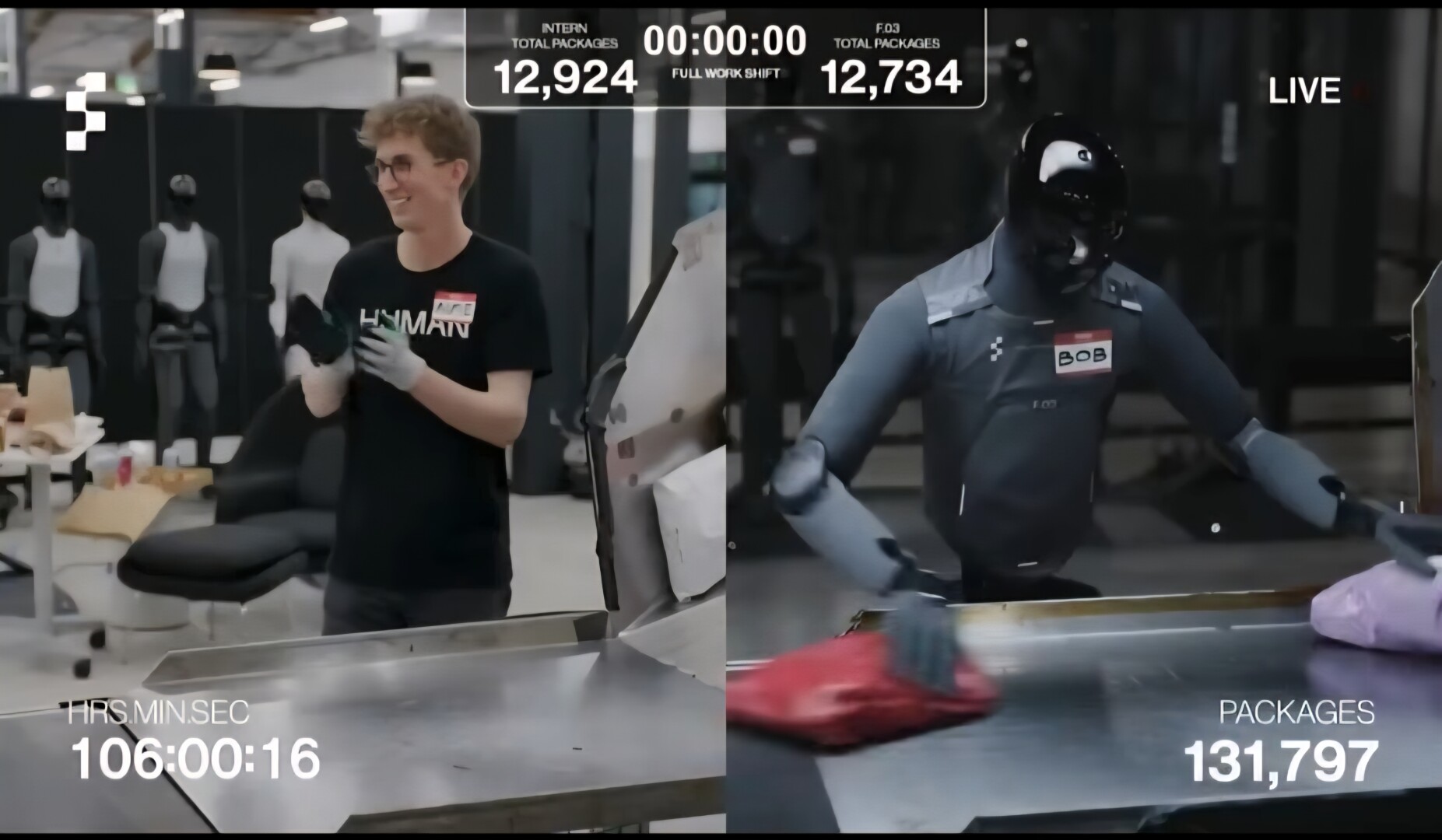
A conveyor belt and a humanoid robot sorting packages. Today this is an unfamiliar image. But in the future it might be the norm. Humanoid robots are moving from viral demos to early commercial reality, and the next phase will be defined by practical tasks, lower costs, and better AI, writes eToro analyst for Romania, Bogdan Maioreanu.
The most important shift is that these machines are no longer being judged only on how human-like they look, but on whether they can reliably work in factories, warehouses, and homes.
The conveyor belt test
Over the past 7 days, several Figure 03 (F03), the newest robots by Figure AI and robotics company, were live on YouTube, sorting packages. It is a simple task for a human to check that every package delivered to the conveyor belt has the label underneath. But for the robot, it is complicated as not all packages are the same; some are soft bags, some are square, and others rectangular. Some packages are more puffed than others, and some are cardboard boxes of different sizes with the label glued all over the place. The robots are learning on the job. In 137 hours, over 170.000 packages were sorted.
What F03 is experiencing at its sorting job is, in fact, the biggest challenge in robotics: spatial artificial intelligence. And to be able to train it, it needs data. Unlike language models trained on vast internet text, robots need physical motion data, which barely exists. Companies are bridging this data gap through virtual simulations of tasks, harvesting videos of people filming themselves doing those tasks, and teleoperation (remotely controlling robots to record training data). Today, in many cases, the robots have expensive hardware that is much more capable than the software inside. This is why we have dancing and kung-fu fighting robots, which are easily scripted movements, but very capable robots are failing to make the bed or to fold the laundry. They are much more difficult tasks due to the variety of the items involved.
Despite the hurdles, the push for autonomous multi‑purpose humanoid robots is beginning. The push comes mainly from economic and labor pressures, and rapid AI and hardware advances. Companies and governments see them as a way to cope with chronic worker shortages in physically demanding, repetitive jobs while keeping factories and warehouses running reliably and safely.
A potential $5 trillion market to conquer
Morgan Stanley estimates the humanoid market could reach $5 trillion by 2050, with adoption accelerating in the late 2030s and 2040s. That timeline matters because the hardest part is not making a robot walk, but making it useful, reliable, and affordable enough to deploy at scale. Though in its infancy, in 2025, the global humanoid robot market experienced a breakout year, led by Chinese vendors, with shipments exceeding 18,000 units, according to an IDC report. Unitree ranks first globally, with 5,500 units sold in 2025, up from around 1,500 a year earlier. Its cheapest R1 model, for instance, costs just $5,900, while the company also sells robot dogs for $1,600. Its competitor AgiBot followed next, seeing 5,168 units sold, with its lowest-cost model standing at $14,500. Over the next 2–3 years, the humanoid robotics industry will enter a pivotal phase, as estimated by IDC. Competition will shift from technical demonstrations to real-world application performance. Vendors with system-level capabilities and engineering execution will emerge as market leaders.
The last time a human will ever win when competing against a robot?
In this picture, the robotics companies at the forefront of the research each illustrate a different pillar of the future. Unitree focuses on affordability and agility with its G1, a compact, sensor-rich humanoid priced in the low tens of thousands of dollars to turn tinkering into real deployment. Agibot stands out for early mass production, recently surpassing 10.000 units produced, with its humanoids deployed across logistics sorting, intelligent manufacturing, security inspection, cleaning, and hospitality services.
Boston Dynamics’ new Atlas robot takes the disciplined industrial route, engineered as an enterprise-grade machine for material handling and order fulfillment, with strong lifting ability, long reach, and robust operation in messy real-world environments. Agility Robotics’ Digit, meanwhile, is already earning warehouse paychecks, performing tote-moving and other material-handling tasks in live logistics facilities under robots‑as‑a‑service deals, and is explicitly designed to work in human environments without major infrastructure changes. While Elon Musk projects humanoid robots will outnumber the human population by 2040, Tesla’s Optimus rollout has been markedly slower, with its third generation to be unveiled sometime this summer. Figure pushes the general-purpose narrative across homes and factories, while the company builds high-volume manufacturing so F03 units can be produced cheaply and repeatedly. Many of these robots are already testing and learning on factory floors.
In the 5 minutes it took to read this article, the F03 robots have sorted over 106 packages, live on YouTube. On Sunday, Figure put its robots head-to-head with an intern to see who sorts the largest number of packages in a regular 8-hour shift. Despite the bathroom, lunch, and the other mandatory breaks, the human won by a slim margin of a bit over 1.3% more packages sorted. 2.79 seconds per package versus the robot, which was a bit slower at 2.83s per package. Aime, the intern, when the challenge ended, said that his forearm was “basically broken.” The humans opened a cold drink to celebrate the victory. “This is the last time a human will ever win,” posted on X Figure CEO Brett Adcock. Meanwhile, the robot continued sorting the packages, live on YouTube, giving us a glimpse into the near future.
_
Unsung hero, six-year-old Henrik, unearths a Viking sword on his school trip
