


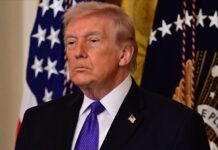
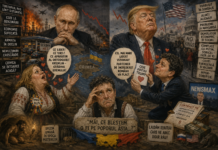





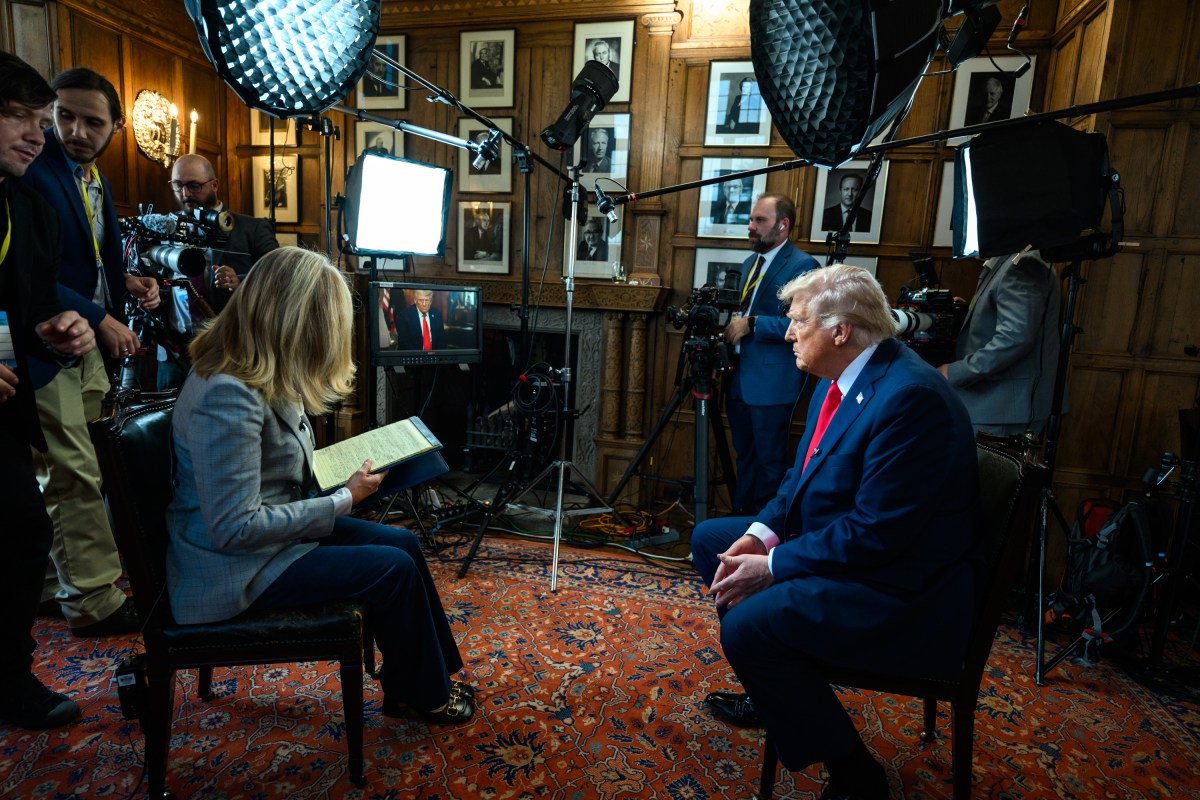
The American president has just made a dizzying pirouette in his stance on the Russian-Ukrainian war, pointing out as follows:
- Kyiv “is in a position to fight and regain the whole of Ukraine in its original form.”
- “The original borders where this war started is a very realistic option.”
- “Russia has been fighting for three and a half years without a specific goal.”
- Russia is “a paper tiger”.
- Ukraine “has a great spirit and is getting better and better.”
- “This is the right time for Ukraine to act.”
- “We will continue to supply NATO weapons so that NATO can do what it wants with them.”
The speed and amount which Donald Trump changes his mind is mind-boggling, given the geopolitical pornography he orchestrated in February, in the Oval Office, against Ukrainian President Volodymyr Zelensky; and the episodes in which Trump’s administration has effectively cut off essential military support to the Ukrainian military, putting them at mortal risk on the frontline, undermining the commanders’ ability to plan and execute operations; finally, given the meaninglessness courtship of Putin that Trump showed from the very first day in office and which he blindly continued for months.
Of course, even under these conditions, the abrupt and radical change in rhetoric of the US leader is notable and welcome.
However, more important, but no less devoid of possible new emotions for Ukraine and its European allies are the following three questions:
- And what if Trump changes his mind yet again?
- Why did he speak like this?
- And why now?
Using the necessary precaution, given Donald Trump’s instability in foreign policy, I would be inclined to leave as open as possible the possibility that he may have a change of mind or at least back down from his strong stance in favor of Ukraine which he’s been in recent days. We will live and see.
Leaving questions 2 and 3 for the moment, I would start with the last one, because the answer is shorter and more telling.
In the case of “Why now?”, to have a full understanding we need the context:
- Trump’s peace effort failed, Putin emphatically slammed all the doors in his face, and the American president is now in the situation of no longer knowing how to get a handle on his relationship with the Kremlin.
- The Russian economy is finally showing tangible signs that it is suffering weighed down by the war effort. The Kremlin has just decided to increase VAT, but the other bad news for the Russians is that other dramatic “adjustment” measures loom over them. In any case, the state of Russia’s economy has become so serious that even the foggy mind of Donald Trump has begun to understand how things really stand.
- The Moscow-Beijing relationship is increasingly closing ranks, in recent weeks the Russian-Chinese duo has managed to lure India on its side.
Now, let’s develop question 3 – “Why did Trump talk like that?”
Question 3, of course, includes all the elements of the answer to question 2, but it does not limit itself to them, but significantly broadens the horizon.
And he expands it on at least four dimensions, each with its own hypothesis, only one more gratifying, and the others more or less worrying:
- Trump spoke like this, finally showing he was determined to take Ukraine’s side because, as Trump himself explained: “I have come to know and fully understand the military and economic situation of Ukraine/Russia.” If this is indeed the case, then, in these circumstances, we should not fear that Trump could change his mind, but that, on the contrary, he will act accordingly. But the vulnerability of this scenario lies precisely in Trump’s explanation: if the US president needed so long to understand such an obvious thing, this begs the question that the problem related to lack Trump’s knowledge will not disappear completely overnight, but will also generate new unfortunate surprises for Ukraine and its European allies from time to time.
- Trump spoke like this because it has finally become clear for him, or it has finally been clarified that the more Russia gets weaker if the US helps Ukraine, the more Trump can can weaken China by weakening Russia. China is a vital factor for Russia. Numerous serious analyses have demonstrated for months and years that Moscow’s war machine depends both financially and technologically on Beijing’s support. Moreover, in July, China’s foreign minister had explained to the head of EU diplomacy that China cannot afford Russia to lose the war in Ukraine. In addition, an interesting aspect – in an interview with Fox News on Tuesday after meeting with Donald Trump, President Zelenskyy put his finger on the wound, saying:”I think that President Trump can change the attitude of Xi Jinping to this war, because China, we don’t feel that China wants to finish this war,” Zelenskiy told Fox News’ “Special Report” after meeting Trump on the sidelines of the United Nations General Assembly in New York. It can’t be excluded that during the meeting between the two presidents this very theme was touched upon, the Ukrainian leverage that Trump could access to change Xi’s attitude. In any case, it would be a theme to Donald Trump’s liking, especially since the American president has not only been defied to the maximum by Putin, but is also rapidly losing ground to Xi, both in the trade war declared against Beijing and in terms of the global affirmation of China’s political-military posture.
- A third dimension of answer to the question “why did Trump speak like this?” would be the purely mercantile one: if I still fail to stop the war, then at least make money from it. And the truth is that, in recent weeks, the US and NATO allies have agreed on a mechanism through which American support for Ukraine will flow in the form of arms purchases contracted and paid to America by Europeans. In other words, even if peace i 24 hours won’t happen, at least it will be a profitable war for America’s treasury and economy. It’s true, it’s a slightly reductionist hypothesis, but often reductionist is also Trump’s perspective in both domestic and foreign policy, just as his appetite to extract dollars from absolutely anyone (see the bitter countries of Asia and Africa, badly hit by his tariffs) and regardless of the circumstances (see the case of Ukraine, a country from which he blackmailed economically against post-war security guarantees and from which he made arrangements to earn money during the conflict).
- The last hypothesis that would provide an answer to question 3 is probably the bleakest of all: we can’t exclude that Trump will consider it a blessing for the Europeans to support the defense of Ukraine at the same time as a gradual disengagement of the US from Ukraine, in particular, and from Europe, in general. A recent Reuters analysis credibly probes precisely this perspective. And as one RUSI expert remarked, quoted in the report,”So the narrative around what he is saying has shifted but he still seems to be making it about distancing the U.S. from leading on the conflict. He’s putting it back onto Europe all the time.”
- With Donald Trump at the helm of world affairs, the world had eight months to observe, with justifiably bitter concern, that simple things become suspiciously complicated, and complex aspects suddenly become suspiciously simple.
This is the case with the US president’s radical change in rhetoric regarding Ukraine, Russia and the war between these two countries.
